Birch plywood weight: how to calculate it by sheet size and thickness
Birch plywood weight determines how many sheets fit on a truck, how each panel is handled and how much weight a floor or side wall adds. Formula, table by thickness and sheet size, and examples using KEFI data-sheet values.
Birch plywood weight affects almost every purchasing decision, even though it rarely appears in the first request for quotation. It determines how many sheets fit on a truck, how many people are needed to fit a panel, which forklift the warehouse needs and how much weight a floor or side wall adds to a vehicle. A calculation error rarely breaks anything, but it does lead to poorly planned transport, surprises at goods receipt and quotations that do not add up.
This guide explains how to calculate birch plywood weight from data-sheet values, using a simple formula and reproducible examples. It separates three figures that are often confused: weight per square metre (kg/m²), weight per sheet and weight per pallet or shipment. The values used come from the published data sheets of KEFI products; they are for planning and do not replace the delivery note or packing list of a specific order.
1. Three different figures: kg/m², kg per sheet and kg per pallet
Plywood data sheets normally state an approximate weight in kg/m² for each nominal thickness. This is the most useful figure because it does not depend on the sheet size: an 18 mm panel weighs the same per square metre in 1250 × 2500 as in 1525 × 3050.
kg/m²: the data-sheet value for each thickness. Use it to compare products and to calculate floor, wall or component areas.
kg per sheet: kg/m² multiplied by the sheet area. This is the figure that matters for manual handling, machining and fitting.
kg per pallet or shipment: the weight of all sheets plus packaging (pallet, straps, corner protectors, cover). This is the figure that matters for transport and unloading.
When a supplier or haulier asks for "the weight", it is worth asking which of the three they mean. Confusing kg/m² with kg per sheet multiplies the error by roughly three to almost five, depending on the sheet size.
2. The formula for calculating birch plywood weight
The basic calculation needs only two inputs: the approximate weight per square metre for the chosen thickness and the sheet dimensions.
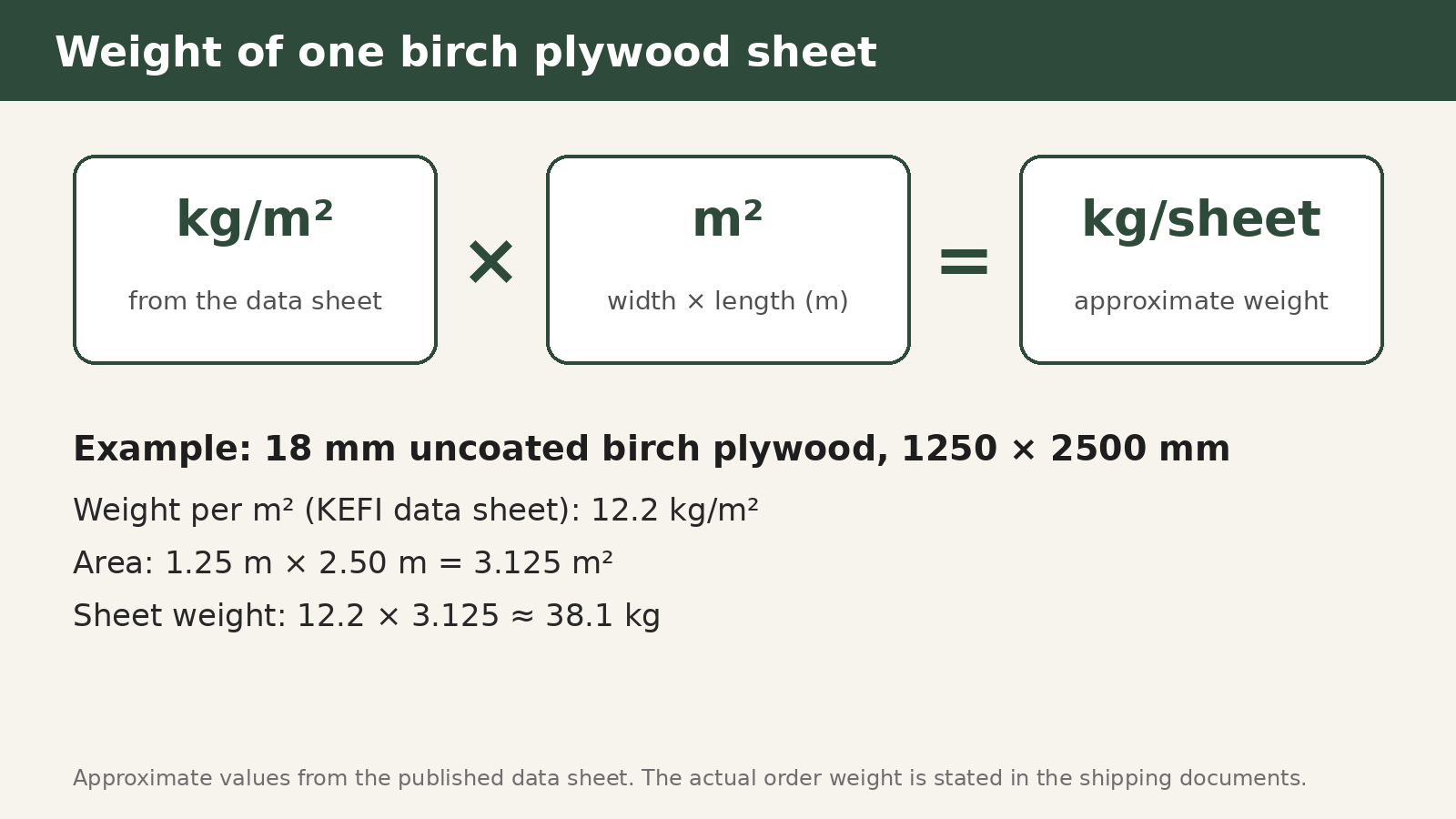
Sheet weight (kg) = weight per m² (kg/m²) × width (m) × length (m)
If the data sheet only gives density, the equivalent calculation is:
Calculation formula using data from the KEFI uncoated birch plywood data sheet.
Both formulas give the same result when consistent data are used. The data sheet for smooth phenolic birch plywood FF states a density of 640–700 kg/m³, and the kg/m² values in its table correspond to about 680 kg/m³ on the nominal thickness. That is why, when the kg/m² table for the specific product is available, it is better to use it directly: it already reflects the actual panel construction.
Sheet weight: 12.2 × 3.125 = approximately 38.1 kg.
With the same thickness in 1525 × 3050 mm, the area is 4.651 m² and the approximate sheet weight rises to 56.7 kg. The thickness is the same, but the large sheet weighs almost 50% more, which matters if it is handled manually.
3. Weight table by thickness and sheet size
The table below applies the formula to the kg/m² values published in the data sheet for uncoated birch plywood (the same values appear in the smooth phenolic FF data sheet). Results are rounded to one decimal place and are approximate.
Nominal thickness (mm)
Veneers
Approx. weight (kg/m²)
Sheet 1220 × 2440 (kg)
Sheet 1250 × 2500 (kg)
Sheet 1525 × 3050 (kg)
6.5
5
4.4
13.1
13.8
20.5
9
7
6.1
18.2
19.1
28.4
12
9
8.2
24.4
25.6
38.1
15
11
10.2
30.4
31.9
47.4
18
13
12.2
36.3
38.1
56.7
21
15
14.3
42.6
44.7
66.5
24
17
16.3
48.5
50.9
75.8
27
19
18.4
54.8
57.5
85.6
30
21
20.4
60.7
63.8
94.9
Not every sheet size is available in every thickness or for immediate delivery. The table is for estimating; actual availability is confirmed in each quotation.
Film-faced panels for vehicle bodies: FW and HEXA
The data sheets for FW anti-slip birch plywood and HEXA anti-slip plywood publish their own weight table, slightly higher for several thicknesses. For example, 12 mm is listed at 8.5 kg/m² and 18 mm at 12.3 kg/m². For an 18 mm sheet in 1250 × 2500 mm, the approximate weight is 12.3 × 3.125 = 38.4 kg; in 1525 × 3050 mm, about 57.2 kg. When calculating an FW or HEXA floor, always use the table in its own data sheet, not the uncoated plywood table.
4. Why actual weight can differ from the calculation
The data-sheet weight is an approximate reference. Several factors explain small differences between the calculation and the scale:
Wood moisture content. The KEFI data sheet states that dimensions and thicknesses are measured at a moisture content of 8–12%. A panel stored in a humid environment can gain weight; a very dry one can lose it.
Thickness tolerance. A nominal 18 mm panel can measure between 17.1 and 18.1 mm according to the data sheet. That difference affects weight proportionally.
Natural density of birch. Wood is not a uniform material: the FF data sheet gives a density range, not a single value.
Coating. Phenolic film (120 or 220 g/m² according to the FF data sheet) and edge sealing add weight. For FW and HEXA, the published table already reflects this.
Special construction. Custom thicknesses or properties, available on request, may have a different weight table. In that case, ask for the manufacturer's figure for that product.
For an order, the definitive figure is the one in the shipping documents. The preliminary calculation is for planning and for spotting obvious errors in a quotation.
5. From sheet weight to pallet and shipment weight
Pallet weight is the sum of two parts:
Pallet weight (kg) = number of sheets × sheet weight + packaging weight
The number of sheets per pallet depends on thickness, sheet size and how the shipment is prepared, so it should be taken from the quotation or packing list, not from a general rule. The packaging weight (wooden pallet, straps, corner protectors, cover) is also provided by the supplier.
Calculation example with an assumed figure: if a quotation stated 40 sheets of 18 mm uncoated plywood in 1250 × 2500 mm per pallet, the sheets would weigh 40 × 38.1 = approximately 1,524 kg, plus packaging. This number of sheets is only an example to show the method, not a standard pallet configuration.
For volume-based planning, remember that one 18 mm sheet in 1250 × 2500 mm occupies 0.05625 m³; about 17.8 sheets of that size make up 1 m³. Many prices and loads are expressed in m³, so it helps to have both figures at hand.
Checks before transport
Total shipment weight against the vehicle's permitted payload, according to its documentation.
Weight per pallet against the capacity of the forklift and unloading bay.
Sheet size against the internal dimensions of the body or platform.
Distribution of pallets on the platform and load securing.
6. Plywood weight and vehicle body weight
In vans, trailers and truck bodies, plywood weight is part of the vehicle's tare weight. The kg/m² table lets you estimate how much a floor or lining weighs before ordering the material: simply multiply the component area by the weight per m² for the intended thickness.
For example, a 10 m² floor in 18 mm FW would weigh about 123 kg (10 × 12.3), excluding fixings, offcuts and waste. If a 15 mm alternative were considered, the same calculation would give 105 kg. This comparison is useful for the weight budget, but it does not decide the thickness: the choice depends on support spacing, loads, type of traffic and the body builder's technical validation. You can find more on these criteria in the guide on buying plywood for trailers.
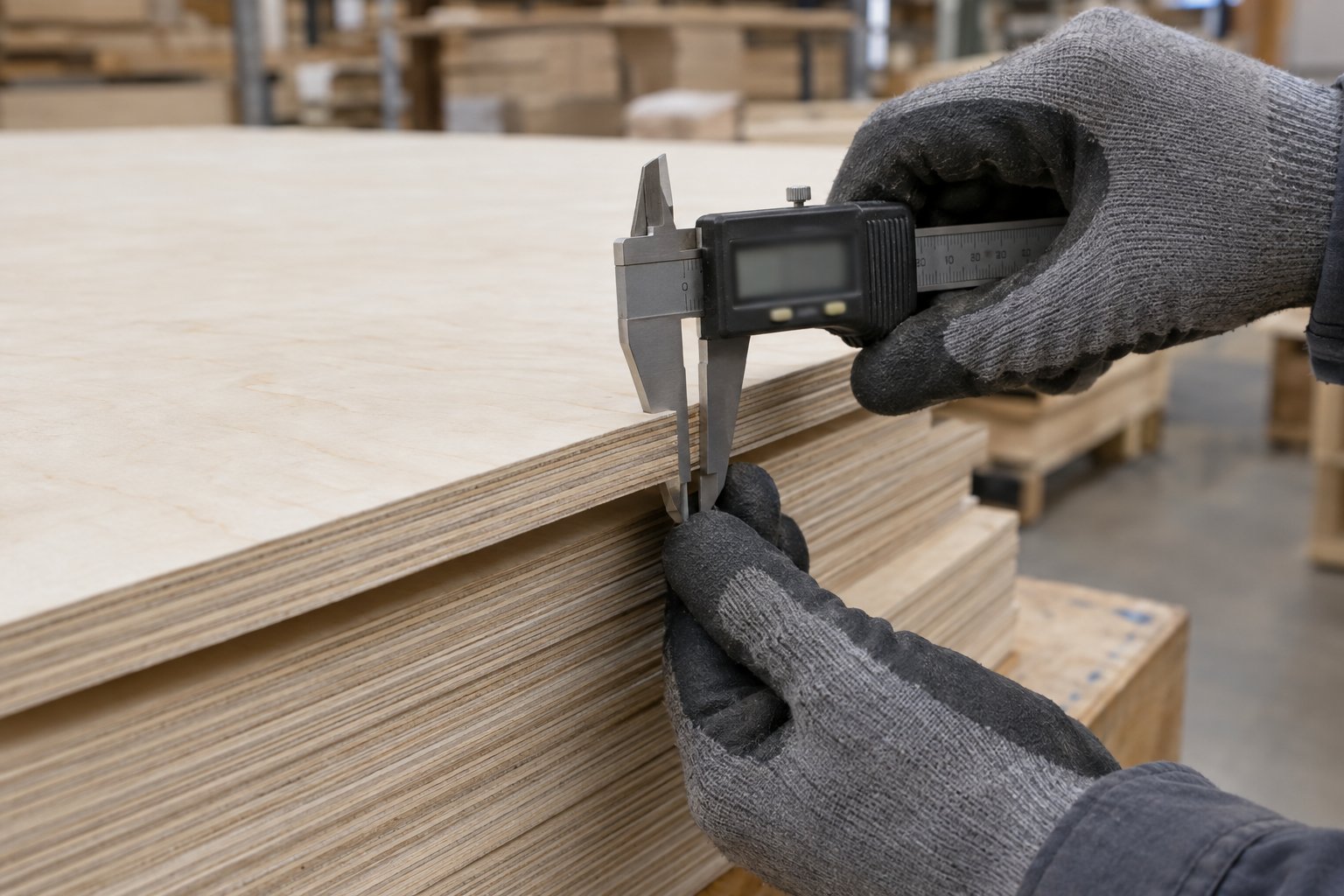
Illustrative image: thickness check at goods receipt.
7. What information to request to know an order's weight
To make the calculated weight match reality, ask for the following in the quotation or order confirmation:
Exact product reference, nominal thickness and sheet size.
Approximate weight per m² for that product, according to the current data sheet.
Number of sheets per pallet and number of pallets.
Gross weight per pallet and total shipment weight.
Dimensions of each pallet, including height.
Unloading conditions and equipment needed at destination.
At goods receipt, a simple check is to weigh or measure a sample sheet and compare it with the calculation. Small differences are normal; a large difference suggests checking the product reference, thickness or moisture content.
Frequently asked questions
How much does an 18 mm birch plywood sheet weigh?
According to the KEFI uncoated birch plywood data sheet (12.2 kg/m²), a 1250 × 2500 mm sheet weighs about 38.1 kg and a 1525 × 3050 mm sheet about 56.7 kg. For 18 mm FW or HEXA (12.3 kg/m²), the values are about 38.4 kg and 57.2 kg respectively.
What is the density of birch plywood?
The KEFI smooth phenolic FF data sheet states 640–700 kg/m³. To calculate the weight of a specific product, its kg/m² table by thickness is more reliable.
Does phenolic film change the weight much?
It adds some weight, but the difference is small compared with the wood. In the FW and HEXA data sheets, the weight table already includes the film-faced construction; use that table for these products.
How do I calculate the weight of a pallet?
Multiply the number of sheets on the pallet by the weight of one sheet and add the packaging weight. The number of sheets and the packaging should be taken from the quotation or the order's packing list.
Can I choose a trailer floor thickness based on its weight?
No. Weight helps estimate tare, but the right thickness depends on the structure, support spacing and loads, and must be validated by the person technically responsible for the vehicle.
Request a quotation with weights and sheet sizes
If you are preparing an order for uncoated birch plywood, smooth phenolic FF, FW or HEXA, tell us the thickness, sheet size, quantity and delivery destination. We will send you a quotation with availability, transport conditions and the weight data you need to plan the load. Price, taxes, transport and lead time are confirmed in writing in each quotation.