How to buy plywood for trailers in Spain: specification, sizes and receiving checklist
Buying plywood for a trailer is not simply a matter of choosing the thickest sheet or comparing a unit price. A trailer floor works under point loads, wheels, vibration, braking, moisture and repeated washing. Sidewalls, doors and ramps have different requirements for stiffness, machining and weight. For a body builder or fleet buyer, a safe purchase starts with a technical brief that makes equivalent references comparable and ends with a documented receiving check.
Buying plywood for a trailer is not simply a matter of choosing the thickest sheet or comparing a unit price. A trailer floor works under point loads, wheels, vibration, braking, moisture and repeated washing. Sidewalls, doors and ramps have different requirements for stiffness, machining and weight. For a body builder or fleet buyer, a safe purchase starts with a technical brief that makes equivalent references comparable and ends with a documented receiving check.
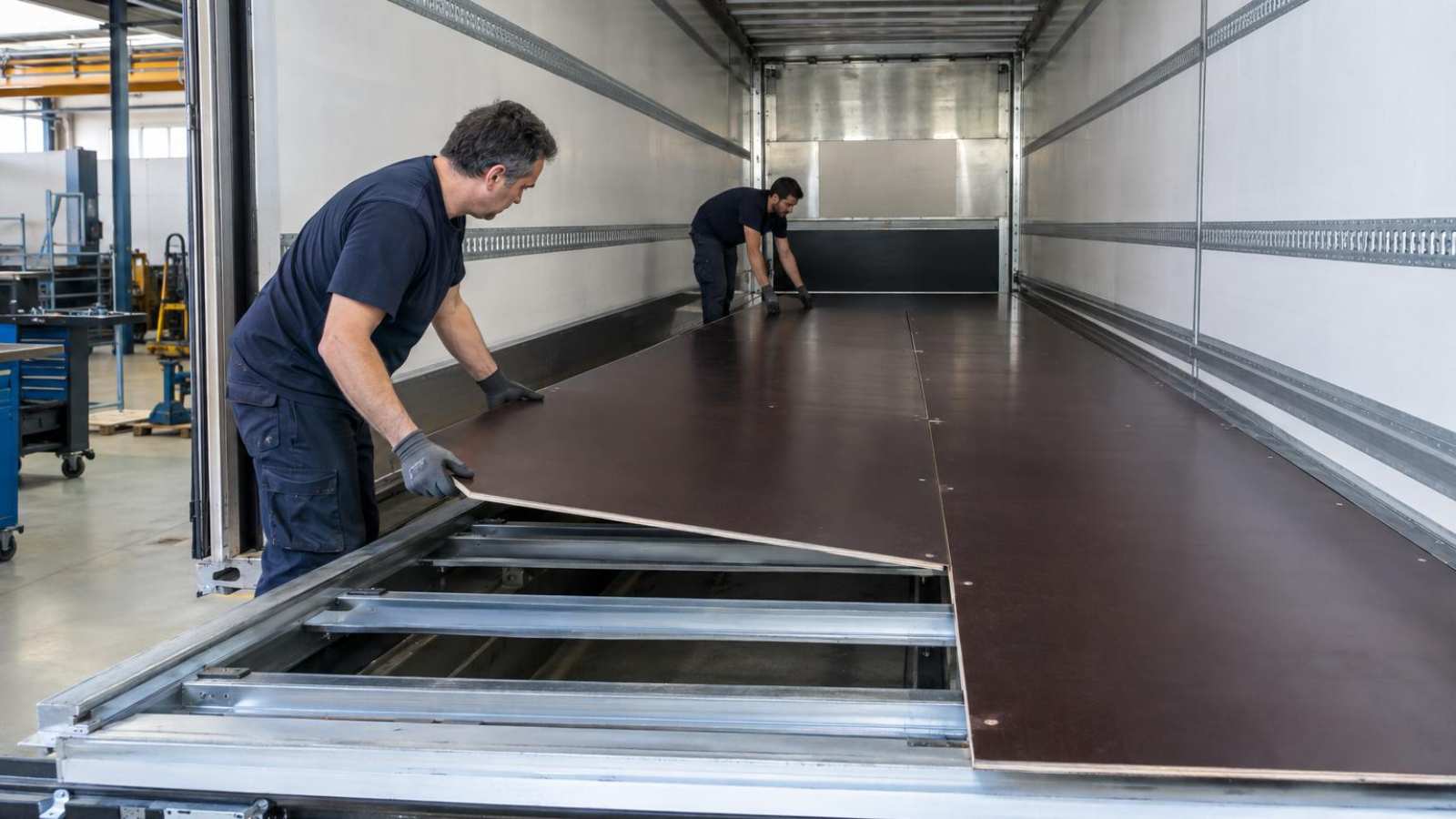
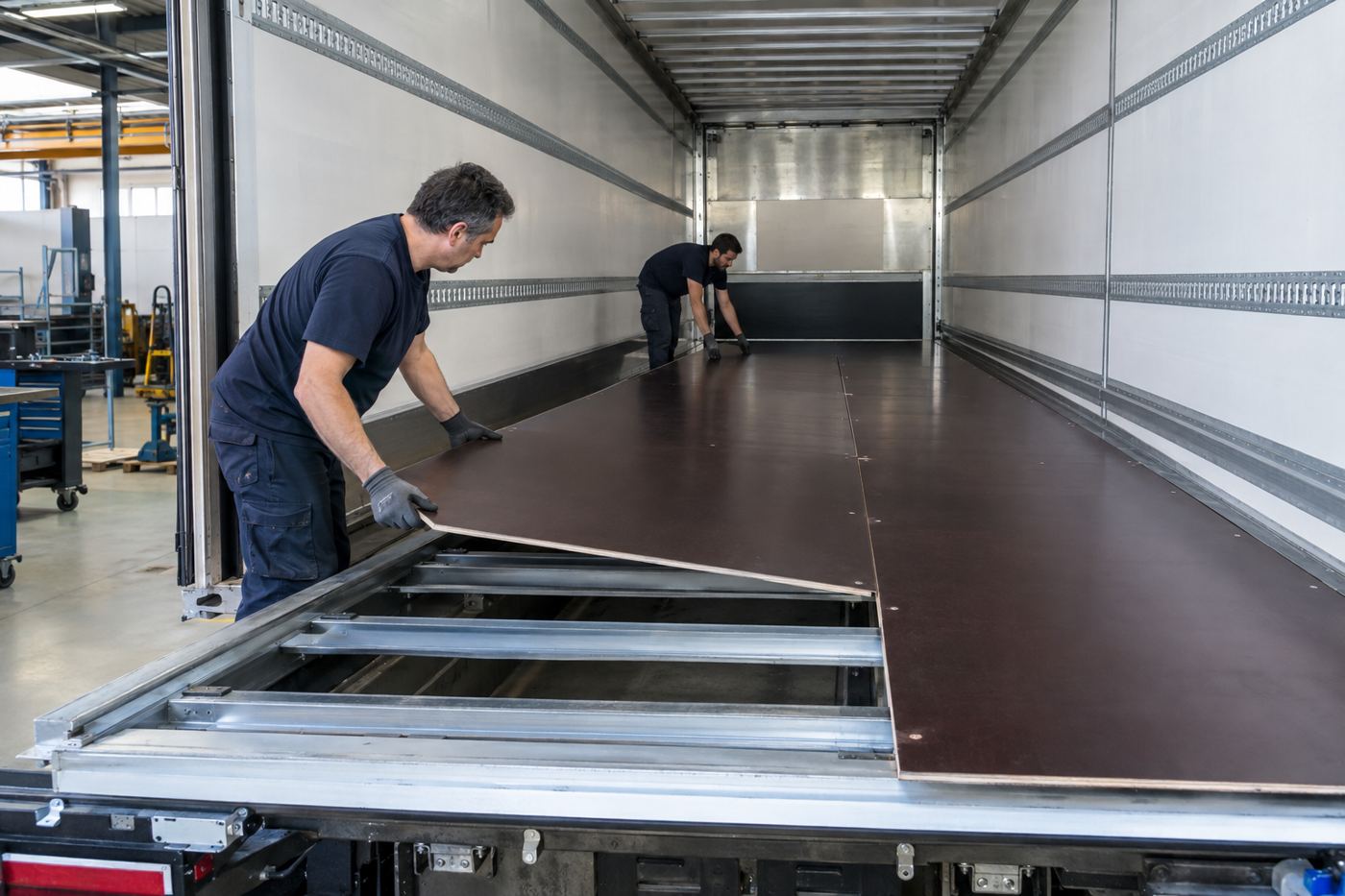
Phenolic plywood floor being installed in a cargo trailer
This guide presents a practical method for specifying, budgeting and receiving plywood for trailers, semi-trailers and platforms. It covers FW, HEXA and smooth faces, explains how thickness relates to support spacing, and includes KEFI price references. The listed amounts are commercial references on a DDP Valencia basis, June 2026, VAT excluded; confirm the current price, availability, format and lead time before placing an order.
1. Define the application before requesting a quote
The first question is not “which thickness?”. It is “what function must each part perform?”. A floor receives vertical load and operating wear. A sidewall protects the structure and may support rails or partitions. A door combines low weight, impact and opening cycles. A ramp adds bending, wheel contact and an especially exposed entry edge.
Prepare a brief for each component with length, width, usable area, crossmember spacing, load type, operating frequency, water exposure, fixing method and planned cut-outs. State whether the load moves by forklift, pallet truck or hand cart. Add the number of trailers in the batch and the required commissioning date. A supplier can help identify a reference, but load calculation and structural validation remain with the vehicle’s technical responsible person.
Exact use: floor, sidewall, door, ramp, partition or lining.
Distributed and point loads, including the type and frequency of traffic.
Support spacing, joint positions and fixing method.
Thickness, sheet size, face finish and edge protection.
Quantity, destination, delivery basis, lead time and required documents.
2. What “trailer plywood” should identify
The commercial description must become a verifiable reference. “Phenolic”, “exterior” or “anti-slip” describes a family or surface, but does not by itself identify the core, bonding, thickness, size or tolerance. In a B2B request, state the application, working face, reverse face, dimensions and batch. If the project has a documentary requirement, request the bonding class under EN 314-2 and ask which declaration or technical sheet accompanies the reference.
Documentation must match the product actually quoted. Check that a smooth-panel data sheet is not being used for a textured panel, or a sheet for one thickness is being used for another. For the distinction between bonding class and declared performance, see KEFI’s EN 314-2 and CE EN 13986 guide.
3. Select thickness by support, load and mass
There is no universal thickness for every trailer. Crossmember spacing changes deflection; a load on four wheels requires a different check from a distributed load; and a thicker panel increases vehicle mass. As purchasing references, 12 mm may suit an interior configuration with close supports, 15 mm provides more section for intermediate duties, and 18 mm or more may be considered for higher-demand floors, always subject to the body builder’s calculation or validation.
Use these figures to begin a technical conversation, not as a universal sizing table. Define allowable deflection, maximum load, support type, joint positions and fixing strength. Nominal thickness does not replace checks on flatness, tolerances and edge quality. In walls and doors, weight can matter as much as strength; in ramps, check the support condition while cargo is entering.
4. FW, HEXA or smooth face: choose the working surface
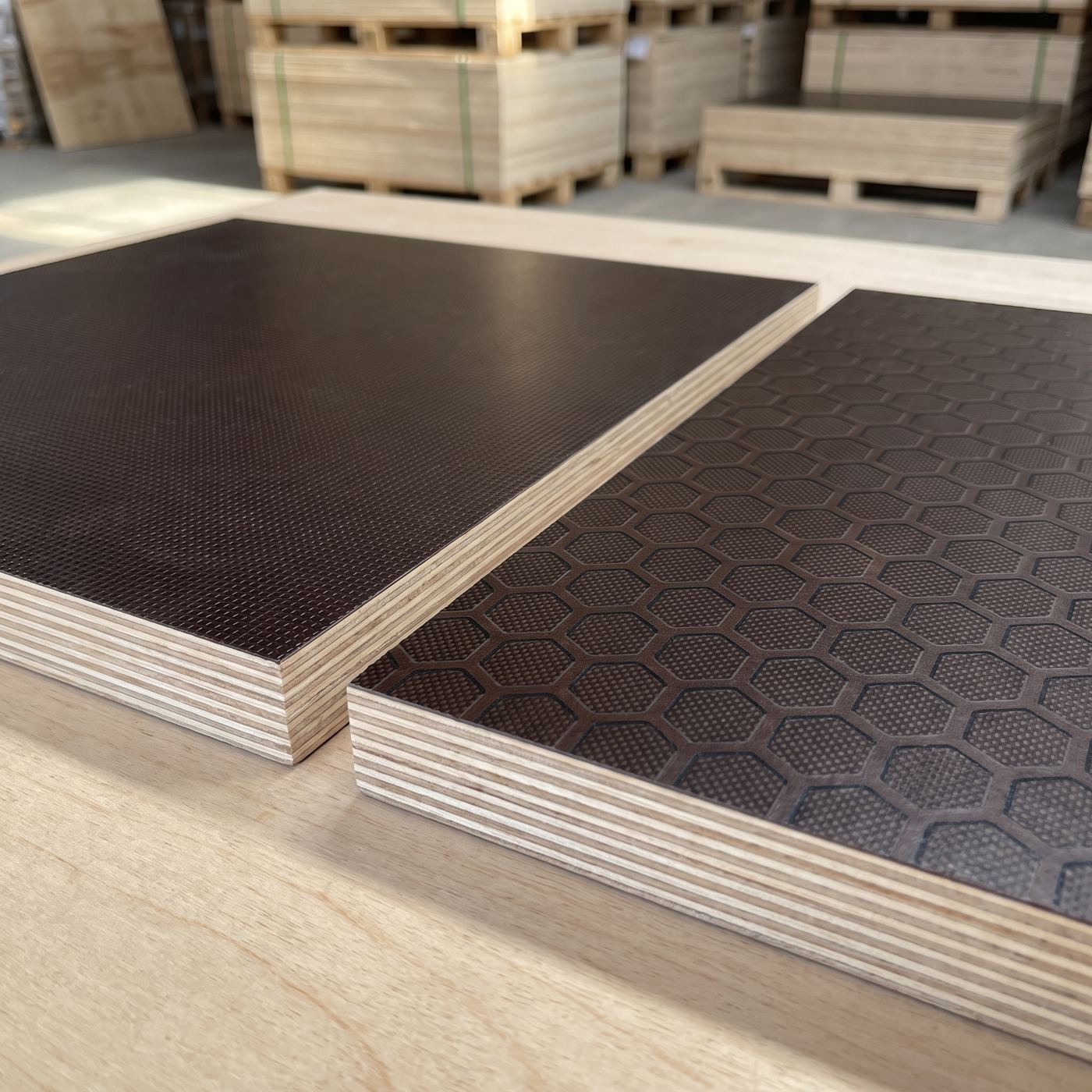
Close-up of FW and HEXA plywood surfaces
FW, with a wire-type pattern, and HEXA, with a hexagonal pattern, are common choices where the floor needs grip and a protective film. The decision should consider wheel type, mud or oil, cleaning, noise, wear and final appearance. A pronounced pattern cannot correct poor support distribution and does not remove slip risk when the surface is contaminated.
For sidewalls, interior doors or partitions, a smooth or film-faced panel may be more practical. It simplifies marking, cleaning and the installation of protection, and can reduce interference with rails or hardware. Compare the working face with the reverse face: one surface combination may suit a floor while another makes door machining easier. KEFI’s FW versus HEXA comparison provides a useful starting point.
5. Size, joints and cutting yield
Choose sheet size with the trailer drawing in front of you. A large sheet can reduce joints and installation time, but it requires adequate access and a cutting plan around wheel arches, posts and thresholds. Smaller pieces may make local replacement easier, while increasing the number of joints and edges that need protection.
Before buying, draw the cutting layout using the actual quoted sheet size. Quantify net area, waste, orientation, number of parts and joint locations over supports. Confirm whether 1525 × 3050 mm is available for the specific reference or supplied on request. A comparable quote should show sheet size, quantity and delivery basis, not only euros per square metre.
6. Machining and installation: protect every edge
The face coating does not automatically seal cuts, holes and corners. After machining, remove chips, inspect the part for flatness and apply a sealing system compatible with the intended use. Keep joints over profiles or supports where the design requires it, and avoid trapping water between the panel and the frame.
Dry-fit the pieces before fixing. Check diagonals, clearances to metal, latch positions and wheel passage. Distribute screws or rivets consistently and avoid torque that marks the face or opens the edge. On a ramp, check the transition with the floor; on doors, check opening cycles; on sidewalls, make sure fixings do not interfere with services.
7. KEFI price references for budgeting
The following KEFI references correspond to 1250 × 2500 mm sheets, DDP Valencia, June 2026, VAT excluded. They are a budgeting basis for comparing solutions, not a future-price promise. Confirm stock, batch, lead time and transport before ordering.
Product
Thickness
€/m²
€/sheet 1250×2500
FW
9 mm
12.73 €
39.79 €
FW
12 mm
15.55 €
48.59 €
FW
15 mm
18.39 €
57.47 €
FW
18 mm
21.47 €
67.11 €
HEXA
12 mm
17.07 €
53.34 €
F/F film-faced
12 mm
15.07 €
47.10 €
For the project total, add waste, machining, fixings, edge sealing, packaging, unloading, internal transport and replacement pieces. If you need a special format, a particular face combination or recurring quantities, send KEFI the trailer brief and request a current quotation before closing the order.
8. How to compare suppliers in a B2B purchase
Ask every supplier for the same information: reference, core construction, thickness, size, face, reverse, bonding class where applicable, tolerances, quantity, lead time, delivery basis and documents. Compare the usable surface actually achieved, not just the sheet price. A panel that reduces joints or waste can lower the installed cost even when its unit price is higher.
For trailer series, consider supply continuity and repeatable machining. A stable reference helps maintain tool settings, installation instructions and replacement parts. Before releasing a large batch, test one sheet: cut, drill, seal the edge and check interaction with wheels, rails and fixings. Record the result and retain the batch number.
9. Receiving the batch: a simple checklist
Thickness and receiving inspection for trailer plywood panels
Match purchase order, delivery note and label: product, thickness, size, face, quantity and batch.
Inspect packaging, corners, edges, visible moisture, distortion and transport damage.
Measure a sample of thickness and size with instruments suitable for the project.
Check pattern, film continuity and any areas that could complicate machining.
Archive the technical sheet, applicable declaration, incident photos and batch acceptance.
Quarantine and report any non-conformity before cutting or installation.
Receiving does not replace design, but it connects the purchase with the material entering production. If a fleet is built over several weeks, record which batch was used in each trailer. This traceability makes replacement, incident analysis and maintenance planning easier.
Frequently asked questions
Which plywood is suitable for a trailer floor?
It depends on load, support spacing, traffic frequency, moisture, working face and fixing system. FW and HEXA are options to compare when grip is required; thickness must be validated against the actual frame geometry and expected load.
Is one large sheet better than several smaller sheets?
A large sheet can reduce joints and waste, but it requires suitable handling and access. Several pieces simplify replacement and cutting, while multiplying joints and edges. Choose from the cutting layout, not only total surface area.
What should I send to receive a comparable quote?
Send use, drawing or dimensions, supports, load, finish, thickness, sheet size, quantity, date, destination, delivery basis and required documents. If there are cut-outs, doors or ramps, include them in the drawing or parts list.
Does the price per square metre equal the real floor cost?
Not necessarily. The installed cost may include waste, machining, fixings, sealing, transport, labour and replacement. Use the square-metre price as a reference and request a quote based on sheet size, quantity, destination and delivery basis.
Request a quotation for your trailer
Send KEFI the trailer use, dimensions, support spacing, expected load, finish, thickness, sheet size, quantity and destination. The team can confirm the available reference, commercial basis and documents that should accompany the order. Contact KEFI for a technical and commercial enquiry.