Raw birch plywood for furniture: specifying visible faces
How to specify face and back grades, edges, grain and finish when ordering uncoated birch plywood for furniture, with a checklist to prepare your enquiry.

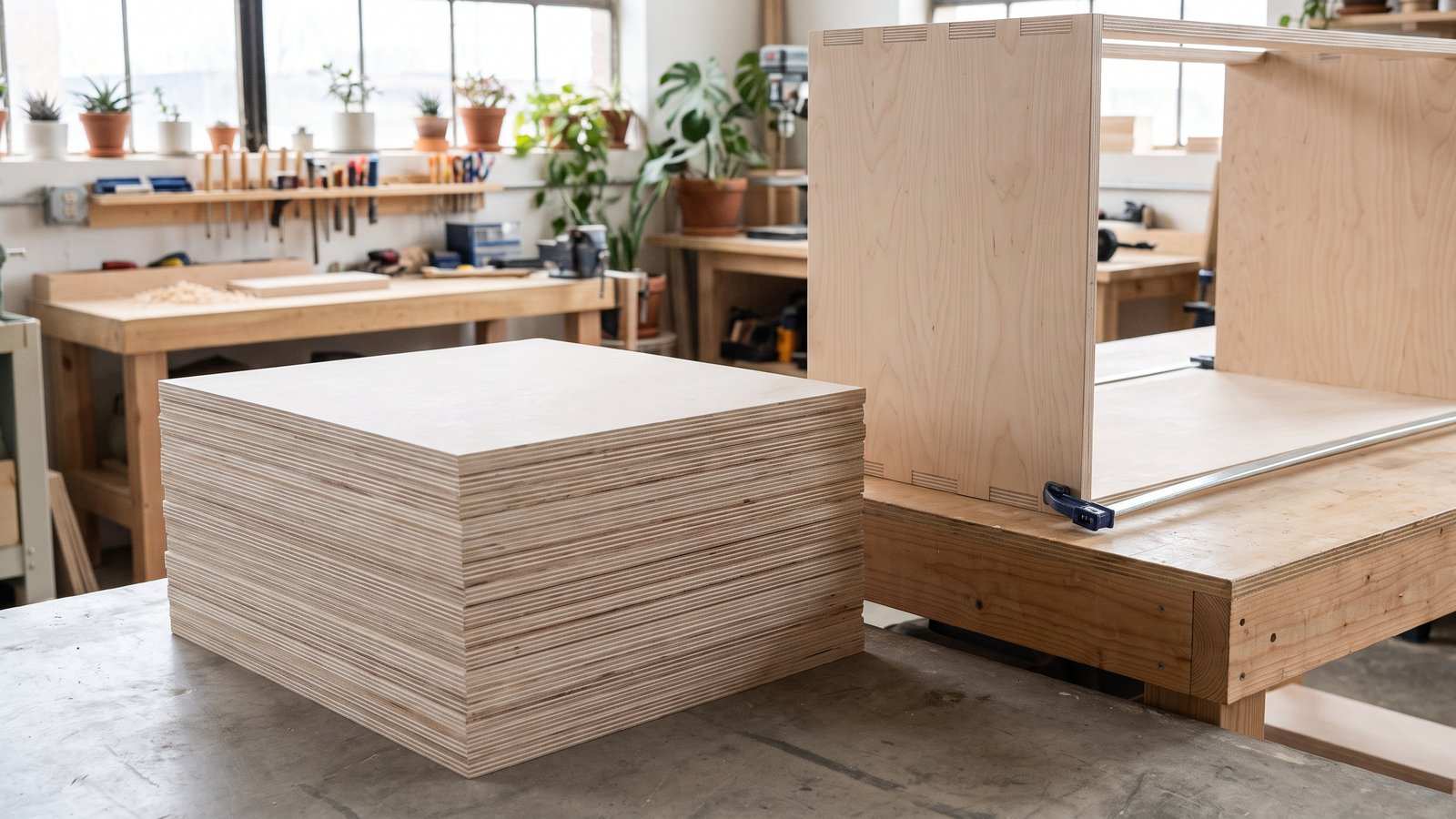
In furniture made from uncoated birch plywood, the face of the panel is part of the design. An order that only says "18 mm raw plywood" leaves open the decisions that matter most for the result: the grade of each face, which side will be visible, how the edge will look and what finish the part will receive. This guide explains how to specify visible faces so that the quotation, the sample and the delivered batch can all be checked against the same criteria.
If you are still choosing between an uncoated panel and a factory-finished one, start with our comparison of raw vs melamine-faced plywood. Here we assume you have already chosen uncoated birch plywood and need to describe it accurately.
Birch plywood is made from cross-laminated veneers. Strength and stability depend on the panel construction and the bonding, but appearance depends mainly on the two outer veneers. That is why surface grades refer to the faces, not to the inside of the panel.
In a wardrobe, a shelving unit or a cabinet front, the same sheet may have one side on show and the other against a wall or inside the carcass. Paying for the top grade on both faces when only one is seen makes the part more expensive; ordering a standard grade for a face that will receive a clear lacquer can leave patches and tone variations on show that the end customer did not expect.
The uncoated birch plywood product page lists these surface grades: B (I), S, BB (II), CP (III) and C (IV). All of them comply with EN 635, which classifies plywood by the appearance of its faces. The page also states that grade B is intended for end uses where a solid surface appearance is required, and that CP and C are recommended where the technical properties of birch plywood matter but surface appearance is not paramount.
| Grade | Equivalent stated on the product page | Furniture use guidance |
|---|---|---|
| B | I | Faces that will be seen with a clear or natural finish; confirm with a sample |
| S | No equivalent stated | Ask for the face description before using it on a visible part |
| BB | II | Visible faces with an opaque finish, or where repairs are acceptable; also inner faces |
| CP | III | Hidden faces or parts where function comes first |
| C | IV | Technical or hidden parts where appearance is not relevant |
The guidance column is a starting point for your enquiry, not a guarantee of appearance. Grade names are not identical across manufacturers: some use different letters or assign the same letter to a different EN 635 class. So it is worth writing both the letter and the face description that the supplier associates with the quoted reference into your order.
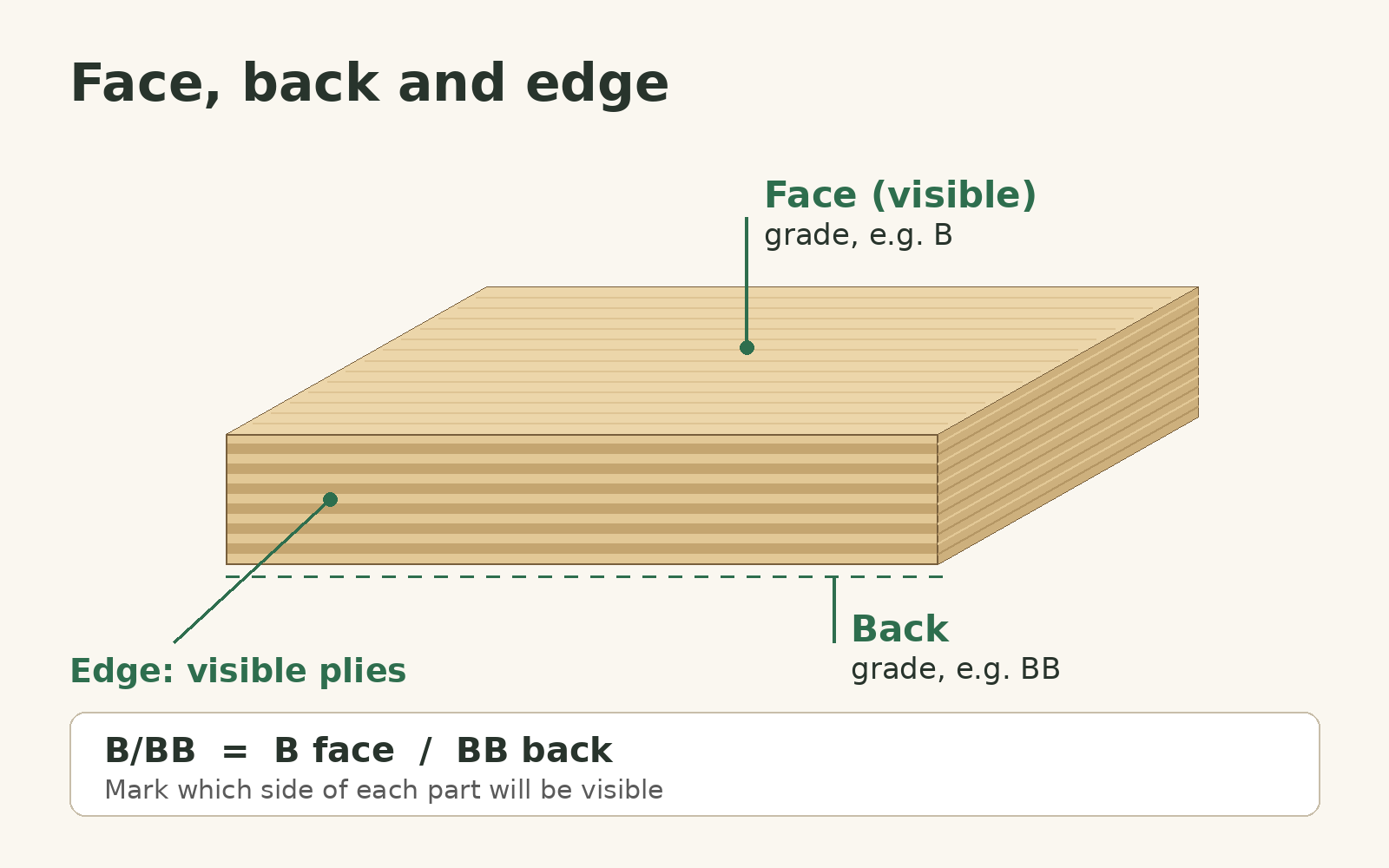
A panel's grade is written as two values separated by a slash: the first is the face, the second is the back. A B/BB panel has a B face and a BB back; a BB/CP panel has a BB face and a CP back. Choose the combination according to how many sides of each part will be visible.
| Part situation | What to state in your enquiry |
|---|---|
| Both sides visible (doors, open shelves, dividers) | The grade required on both faces and whether repairs are acceptable |
| Only one side visible (sides against a wall, backs, tops) | The grade of the visible face and an acceptable lower grade for the back |
| No side visible (inner structure, hidden drawers) | That appearance is not a priority; focus on thickness and bonding |
| Part to be painted with an opaque finish | The planned finish, so we can assess whether a grade with repairs is enough |
On a cutting list, also mark which side of each part is the visible one. That way the workshop places the good face outwards and a part with the right face does not end up assembled the wrong way round.
On fronts and tall side panels, the grain direction relative to the long side of the part changes how the furniture reads. State the orientation you need for each part and confirm how the face grain runs in the quoted sheet size before you prepare the cutting list.
The product page points out that wood is a living material and every panel is unique: a photograph or a sample cannot represent every panel in colour, tone, grain or knots. For a project with many visible parts, ask whether the order can be supplied from a single batch, and set aside sheets for parts that must match, such as a row of doors.
In plywood furniture the edge is often left exposed, showing the plies. The number of veneers depends on thickness: according to the product page, the 18 mm panel has 13 veneers and the 12 mm panel has 9. If the edge is part of the design, ask for a cut sample to judge how it looks with the bonding of the quoted reference, and decide whether it will be left exposed, sanded, lacquered or covered with edge banding.
The range includes phenolic bonding to EN 314-2 class 3 for exterior use or class 1 bonding for interior use, and the product page states that the plywood meets formaldehyde emission class E1 under EN 13986. The class is chosen for the service environment, but it can also affect how the glue line looks on the edge. State the service environment and ask for confirmation of the bonding class of the specific reference.
The finish changes what you see of the face. A clear lacquer, an oil or a light stain highlights grain, repairs and tone differences. An opaque paint largely hides them. A later overlay, such as decorative veneer or laminate, covers the face and shifts the requirement towards flatness and adhesion.
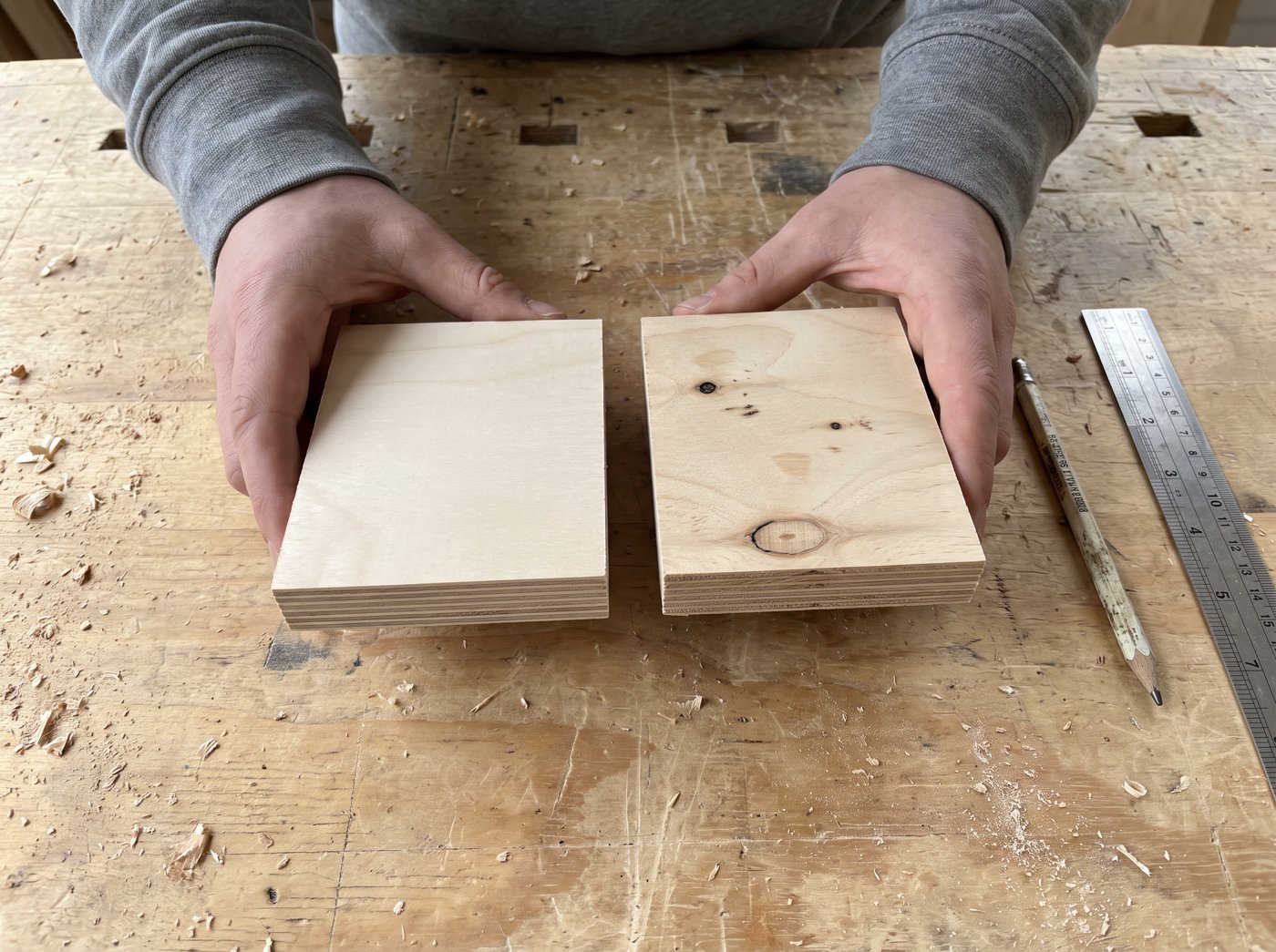
Before committing to production, apply the planned finish to a sample of the quoted reference. Check absorption, the final tone and how repairs look. Also ask whether the surface is supplied sanded and in what condition, as this determines the preparation needed before finishing.
Face grade is no substitute for choosing the thickness. The product page lists nominal thicknesses from 6.5 to 30 mm, with greater thicknesses on request, and these sheet sizes:
The stated length and width tolerances and squareness are ±1 mm/1000 mm, and dimensions are measured at a moisture content of 8–12%. Choose the sheet size with the cutting list in mind: long parts in a size that lets you orient the grain as required, with the least waste. To estimate transport load or handling in the workshop, see our guide to birch plywood weight by sheet size and thickness.
If you need cut parts, the product page states that cut-to-size panels and CNC-machined components are available on request. Send the cutting list with length, width, thickness, quantity, grain orientation and visible side for each part, and confirm the tolerances and operations available in the quotation.
For visible parts, a generic photograph is not enough. A practical way to work is:
For faces that will be seen with a natural finish, the reference is the highest grade in the range, B. Even so, confirm with a sample of the quoted reference, because wood varies from sheet to sheet.
The first value is the face grade and the second is the back grade. B/BB has a B face and a BB back; BB/CP has a BB face and a CP back.
The face grade describes the appearance of the outer veneers. For strength and intended use, specify the thickness and bonding class and ask for the documentation of the specific reference.
It can be, if the finish is opaque or the design accepts repairs and variations. Assess it with a sample and the real finish before deciding.
Cut-to-size and CNC machining are available on request. Mark the visible side and grain orientation of each part on the cutting list.
Send us the thickness, sheet size or cutting list, quantity, the face grade combination you need, the planned finish and the delivery postcode. We will confirm availability, the face grade of the quoted reference, whether a sample is possible and the delivery terms. You can contact us from the uncoated birch plywood product page or from our contact page.