
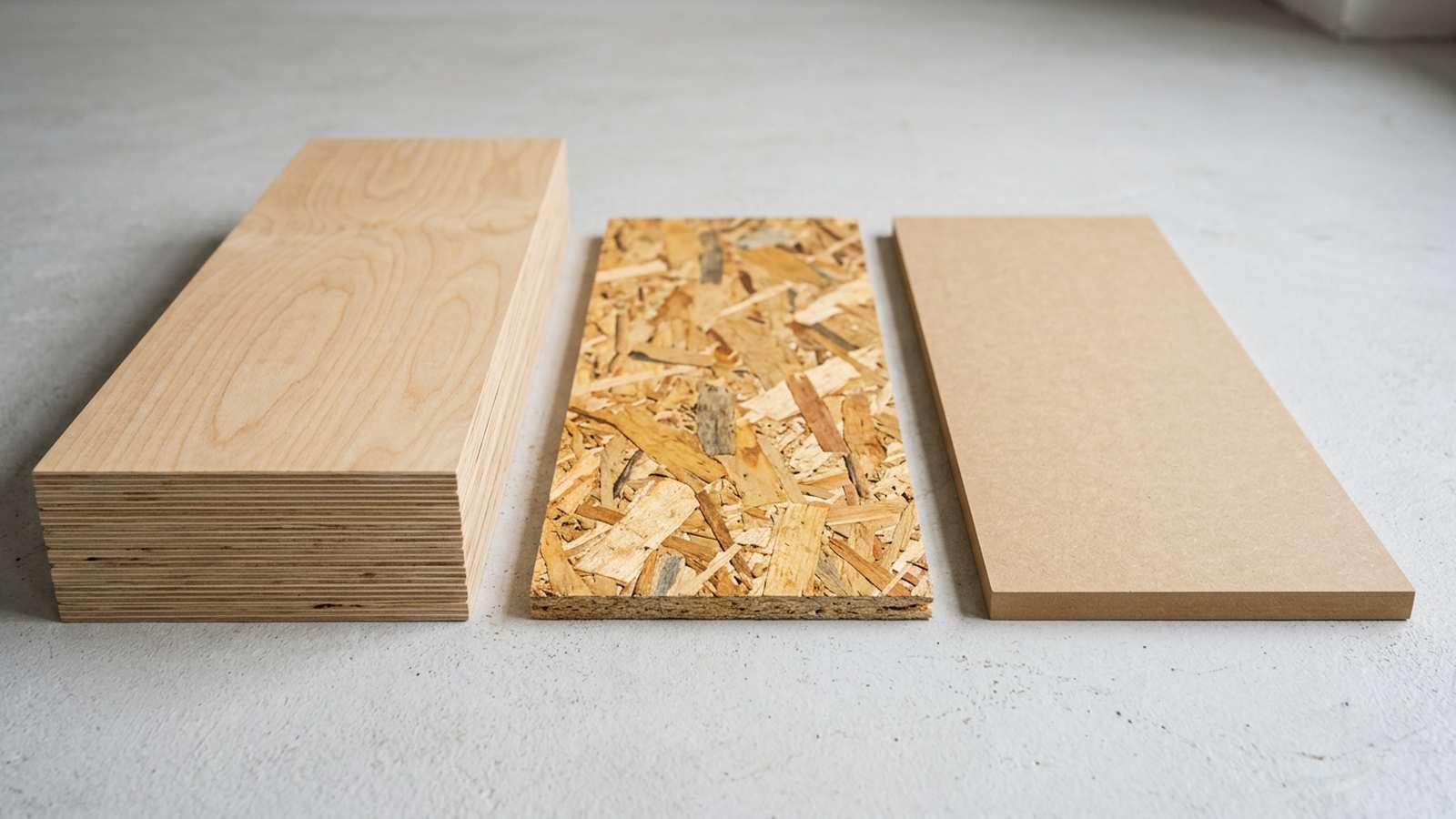
Choosing the right wood board is key to the success of any construction, furniture or packaging project. Plywood, OSB and MDF differ significantly in composition, mechanical performance and moisture behaviour. This technical guide compares all three so that engineers, carpenters and purchasers can see at a glance the advantages and limitations of each.
Plywood
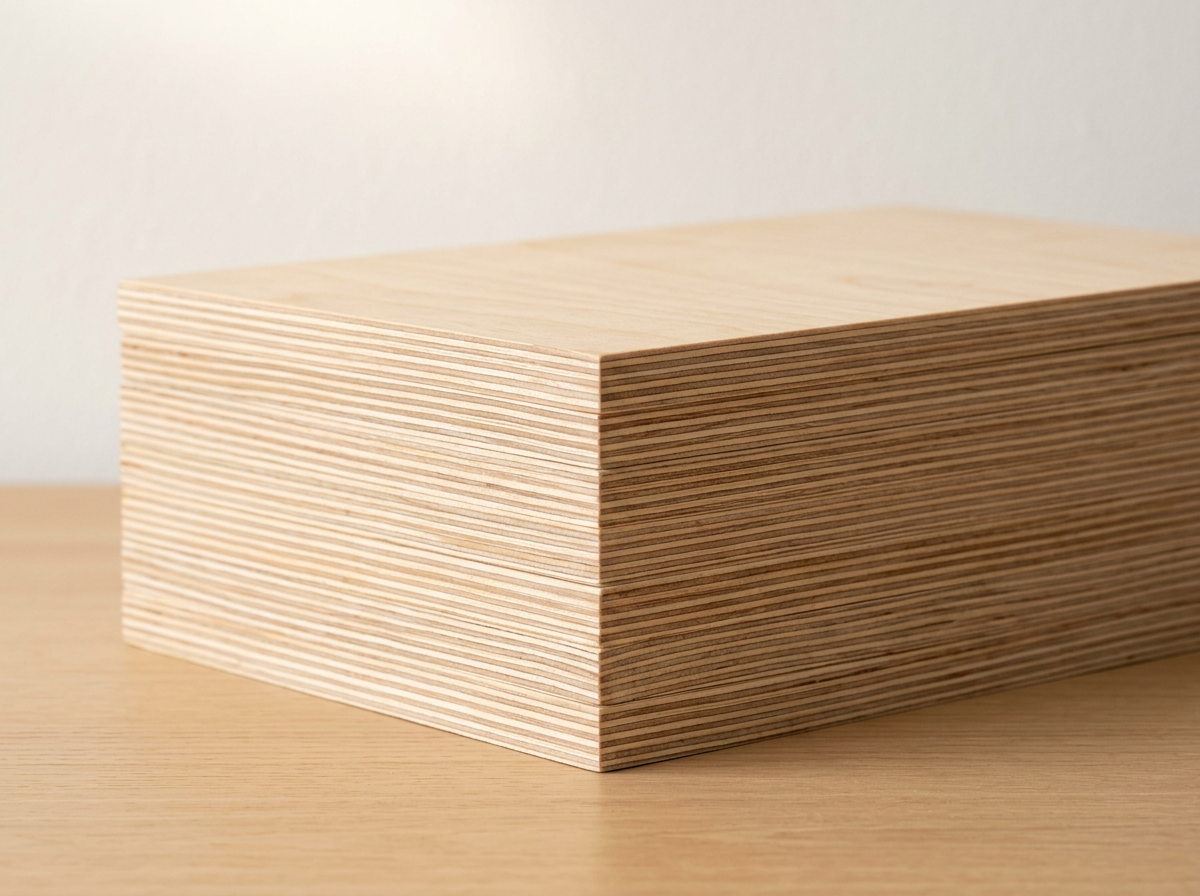
Plywood is made by gluing an odd number of thin wood veneers (e.g. birch) with the grain crossed 90° between layers and pressed with resin. This cross-laminated structure gives an excellent strength-to-weight ratio and strong dimensional stability.
Technical data: typical density 600–750 kg/m³ (birch); phenol-formaldehyde (PF) resin for exterior/humid use; high, bidirectional bending strength; the phenolic version withstands outdoor use and water (formwork, marine, vehicle bodies); formaldehyde emission typically E1 (≤0.124 mg/m³, EN 717-1), E0 and CARB2 (≤0.05 ppm) available; service life 15–25 years.
Advantages: maximum mechanical strength, stability, good edge screw-holding, moisture-resistant version, good finish.
Limitations: medium-high price; edges need finishing; heavier than OSB at equal thickness.
Ideal uses: quality furniture, formwork, technical flooring, vehicle bodies, marine applications.
OSB (Oriented Strand Board)
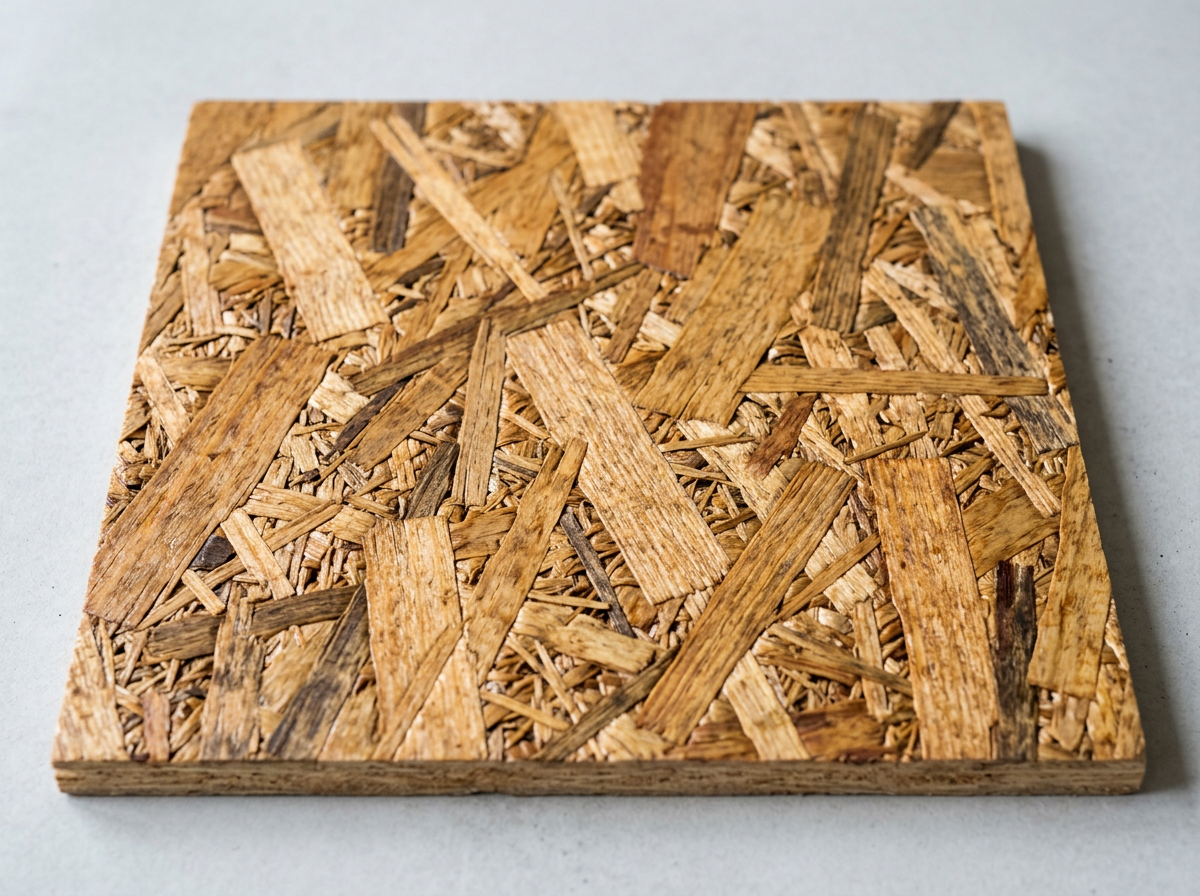
OSB is made from long wood strands oriented in layers and pressed with resins. It is the most economical and sustainable structural board.
Technical data: typical density 600–680 kg/m³; EN 300 classification: OSB/1 (non-structural interior, dry), OSB/2 (structural, dry), OSB/3 (structural, humid — most common), OSB/4 (heavy-duty structural, humid); E1 standard, E0 available; OSB/3 and OSB/4 tolerate ambient humidity (not permanent immersion).
Advantages: excellent value for money, good structural strength, homogeneous, sustainable.
Limitations: rough surface (not for fine visible finish untreated); absorbs water through edges if unsealed; swelling under prolonged exposure.
Ideal uses: roofing, floors, framing, partitions, sheathing, industrial packaging.
MDF (Medium-Density Fibreboard)
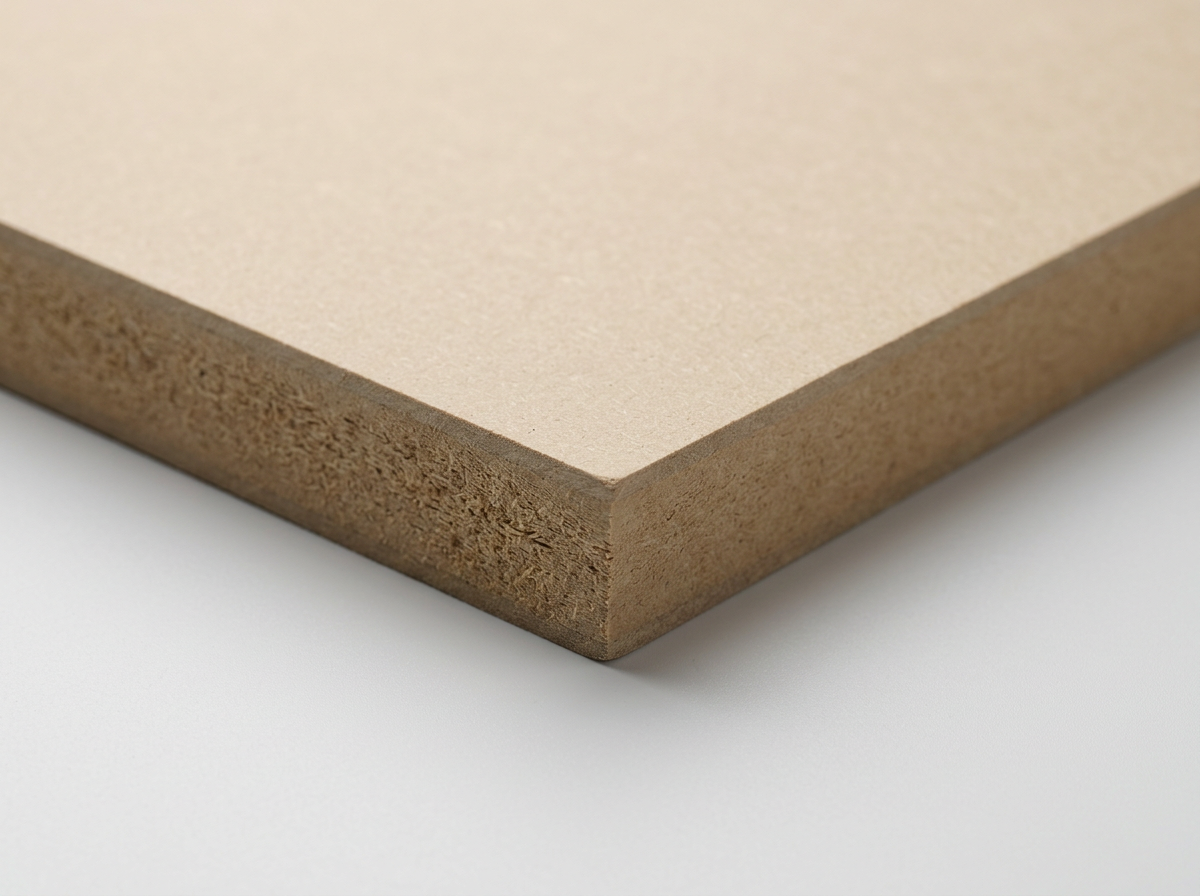
MDF consists of very fine wood fibres mixed with resin and pressed to high density. The result is a smooth surface, free of grain and knots, ideal for lacquering, painting or overlaying.
Technical data: typical density 650–850 kg/m³ (denser and heavier); extremely smooth surface; machinable edges (routing, mouldings); minimum E1 required for interior, E0 or CARB2 recommended for furniture and export; moisture-sensitive (moisture-resistant green MDF exists, not for outdoors); service life 5–10 years indoors.
Advantages: perfect surface for finishes, easy to machine and mould, economical, no grain.
Limitations: heavy; moisture-sensitive (swells); lower mechanical strength and poorer edge screw-holding; cutting dust requires extraction.
Ideal uses: indoor furniture, mouldings, doors, panel backs, decoration, lacquered elements.
Technical comparison
| Criterion | Plywood | OSB | MDF |
|---|---|---|---|
| Density (kg/m³) | 600–750 | 600–680 | 650–850 |
| Mechanical strength | Very high (bidirectional) | High (structural) | Medium |
| Moisture resistance | High (phenolic) | Medium (OSB/3–4) | Low (unless moisture-resistant) |
| Surface finish | Good | Rustic | Excellent (smooth) |
| Edge screw-holding | Good | Medium | Low |
| Formaldehyde emission | E1 / E0 / CARB2 | E1 / E0 | E1 / E0 (slightly higher) |
| Reference standard | EN 13986 | EN 300 | EN 622-5 |
| Service life | 15–25 years | 10–20 years | 5–10 years |
| Price | Medium-high | Low | Low-medium |
Which one to choose?
- Strength, stability and outdoor/humid or water-contact use → phenolic plywood.
- Best cost in structural construction (roofing, floors, framing) → OSB/3 or OSB/4.
- Smooth surface for lacquering or painting indoors → MDF (moisture-resistant if damp).
- Interiors with health requirements or US export → verify E0 or CARB2 class.
At KEFI Bosque Group we are a wholesale supplier of plywood (birch, phenolic PF/PW, melamine), OSB and body panels, with supply across Europe from Spain. Tell us your application, loads and moisture conditions and we will recommend the optimal board and class. Request catalogue and prices.