Phenolic plywood for truck bodies: technical guide and 2026 prices
A guide for bodybuilders, hauliers and workshops on choosing birch phenolic plywood for floors, walls, roofs and platforms in trucks, trailers and vans. Covers FF, FW and HEXA finishes, thicknesses, quantity calculations, indicative prices and buying criteria in Spain.
Choosing truck body phenolic plywood is not simply a matter of comparing the price per panel. A truck floor, trailer platform or van lining is subject to point loads, moisture, friction and continuous cleaning cycles. An unsuitable choice can result in deflection, cargo slipping, damaged edges or premature replacement.
Phenolic plywood for truck bodies: technical guide and 2026 prices
For bodybuilders, fleet operators and logistics companies in Barcelona, Mataró and the rest of Catalonia, the decision must start with the actual use: load, moisture, required grip and vehicle format. This guide explains how to select a phenolic panel for vehicle bodies and estimate the material required.
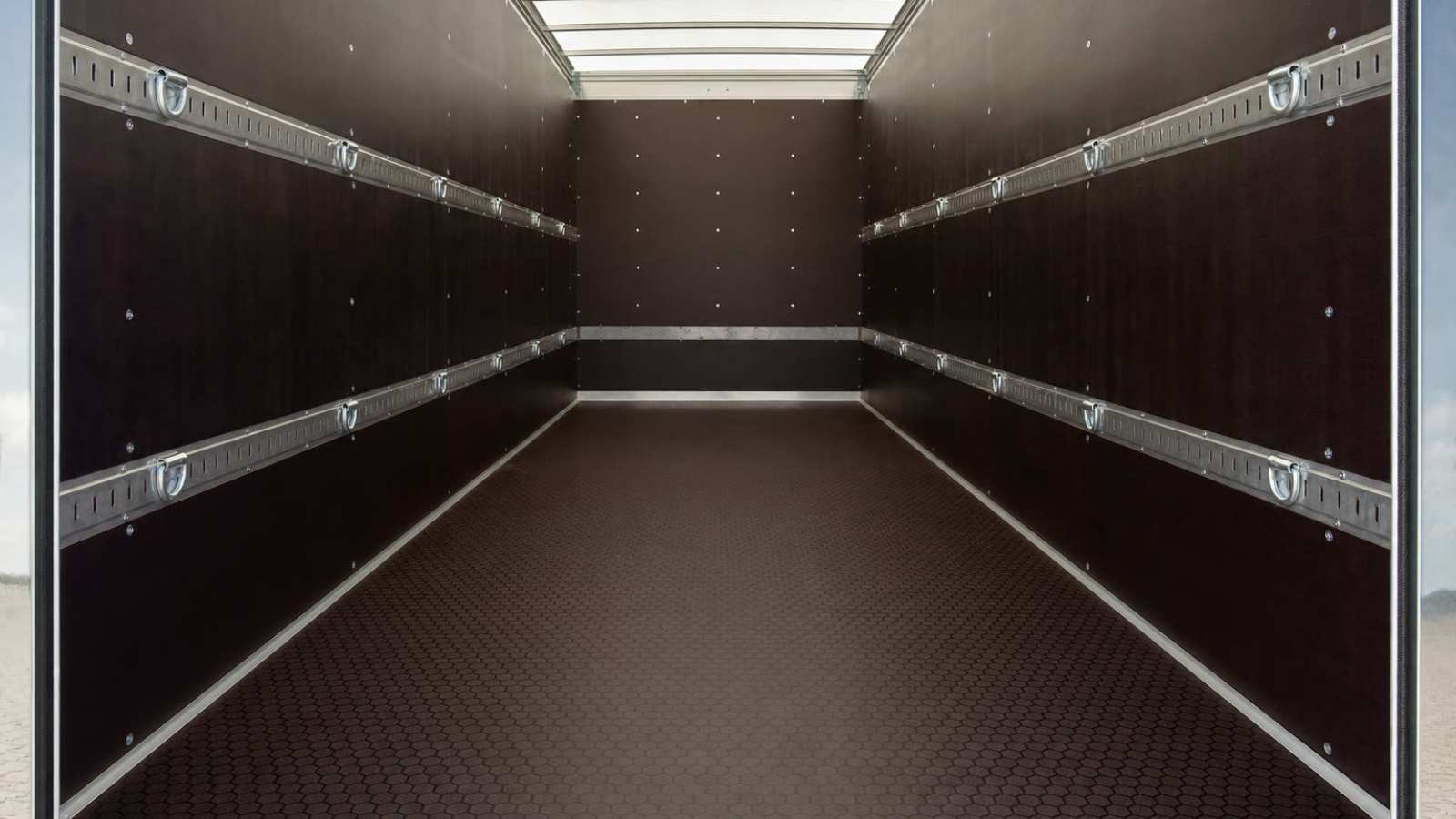
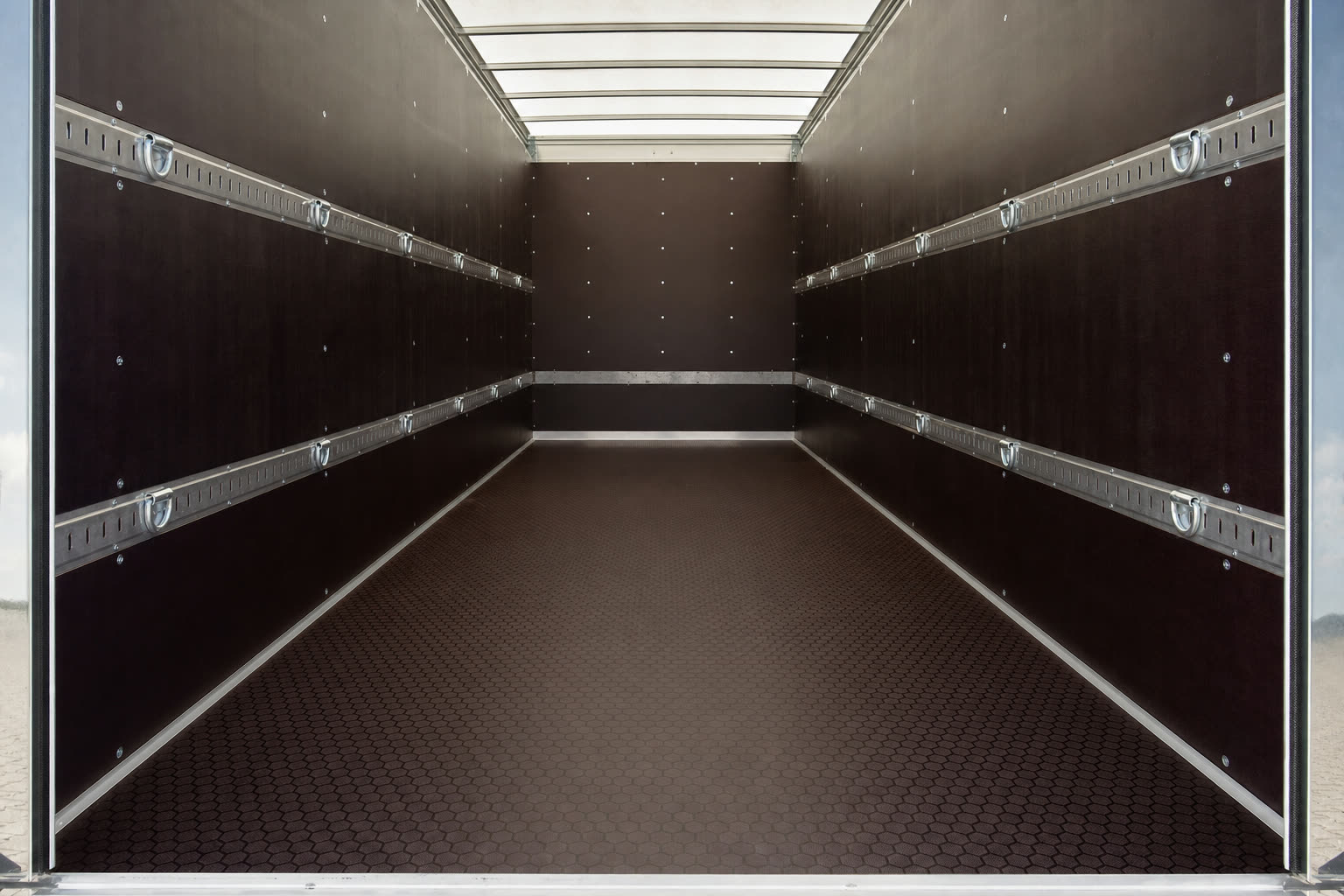
Truck interior with anti-slip HEXA phenolic plywood flooring and load-securing rails. Illustrative photo.
What is phenolic plywood for truck bodies?
Truck body phenolic plywood is a multi-ply panel designed for demanding transport applications. Its veneers are bonded for humid conditions and, depending on the version, coated with smooth or anti-slip phenolic film. This construction combines stiffness, strength and weight.
A plywood panel for vehicle bodies should not be confused with a formwork panel. For a vehicle, the relevant factors are a suitable wearing face, well-sealed edges, thickness suited to the span and a surface that facilitates cleaning and fixing.
At KEFI BOSQUE GROUP, we work with birch plywood of European and Central Asian origin for vehicle-body projects. We offer thicknesses from 6.5 to 30 mm and formats of 1220 × 2440, 1250 × 2500, 1500 × 3000 and 1525 × 3050 mm. This helps reduce joints and waste in long vehicle floors, sides and roofs. See the panel catalogue to review the available product ranges.
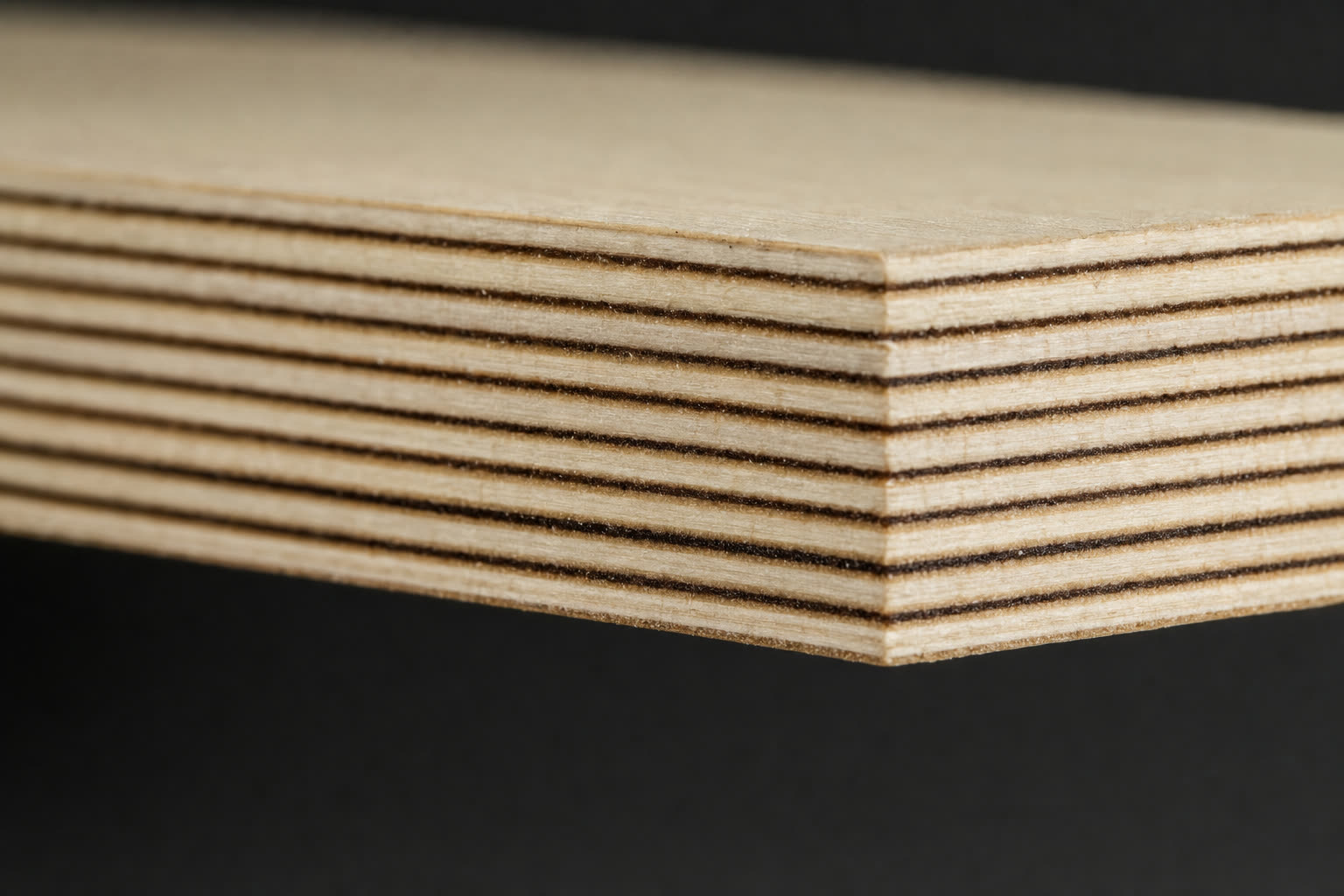
Detail of the multi-ply edges of a birch phenolic panel. The veneer layers and phenolic bond lines can be seen.
Applications in the transport industry
The same truck phenolic plywood is not equally suitable for every truck body. Before specifying the panel, determine which component takes the main load: the floor, side, roof or a movable platform. The choice of thickness and texture must suit that function.
Truck and trailer floors
The floor is the most demanding application. It must withstand forklifts, pallet trucks, wheels, pallets and repeated friction without compromising operator safety. For this function, a phenolic panel for vehicle bodies from 18 to 30 mm is usually the starting point, subject to crossmember design and axle load. Textured surfaces are suitable where an anti-slip truck surface is required for foot traffic and cargo.
Refrigerated bodies are exposed to cleaning water, condensation and temperature changes. The panel must combine an easy-to-clean face with installation that prevents water reaching the edges or substrate. For internal walls, partitions or non-load-bearing elements, a smooth finish is often preferred; for traffic areas, priority is given to grip that is compatible with cleaning.
The finishing film helps simplify maintenance, but it is no substitute for properly sealing the perimeter, machined areas and joints. In a refrigerated body, installation is as important as the plywood panel for vehicle bodies: cut areas must be protected before the vehicle enters service.
Removal and logistics vans
A logistics van handles highly varied loads: furniture, parcels, cages, packages and delivery equipment. Here, a van floor with good grip reduces the risk of movement during loading and unloading. For sides and linings, a thinner panel can protect the sheet metal, improve the finish and provide fixing points for rails or accessories, provided that the structure allows it.
The smooth finish is a practical alternative for visible panels and surfaces that are cleaned frequently. You can review smooth FF plywood with phenolic film for these applications.
Livestock platforms
Platforms for live animals need resistance to use, grip for hooves and a surface that can be washed. The selected texture must prevent slipping without creating areas where dirt accumulates. For this type of bodywork, ramp gradient, ventilation, drainage and the cleaning protocol are also considered. A textured panel can contribute to grip, but final safety depends on the platform as a whole.
Maritime containers
In containers and intermodal equipment, the panel is subject to vibration, stowage and moisture. The 3000 or 3050 mm formats can cover long sections with fewer joints. Calculate the cutting list together with supports and anchor points. For less demanding interiors, see FF melamine-faced panels and FW/HEXA melamine-faced panels.
Surface types: FF, FW and HEXA
The finish designation describes the type of working face. It is not an aesthetic detail: it determines grip, ease of cleaning and the suitability of the panel for a specific area of the truck body.
FF (Film Face): when to choose it
FF is a smooth surface with phenolic film. It is chosen for sides, roofs, partitions or areas where a uniform, easy-to-clean face matters. It is a practical solution for lining van walls.
FF does not provide the traction of a textured surface. For ramps, animals or loads at risk of slipping, consider FW or HEXA.
FW (Film Wire): wire-mesh anti-slip surface
FW combines phenolic film with a wire mesh texture. The embossing increases traction on truck floors, trailers, ramps and loading areas. It is a common option where anti-slip performance is the main criterion.
The wire mesh may retain more dirt than a smooth face; include its cleaning in the maintenance plan.
HEXA: hexagonal anti-slip surface
HEXA uses an embossed hexagonal pattern to improve grip on transport platforms and floors. It may be of interest where an anti-slip texture with a distinctive visual appearance is sought.
Choose between FW and HEXA on the basis of a sample, the load type, the area of use and the bodybuilder's specification. Compare both in the guide FW versus HEXA for truck flooring.
Recommended thicknesses by application
Thickness is not selected solely according to the vehicle's total load. Crossmember spacing, wheel diameter, point impacts, cut-outs and fixing are also important. The following table is indicative; the person responsible for the bodywork must validate the final design.
Application
Indicative thickness
Recommended finish
Aspect to validate
Wall and door lining
6.5–12 mm
FF or melamine
Fixing and hardware points
Van roofs
6.5–9 mm
FF
Weight and curvature
Light van floor
12–15 mm
FW, HEXA or FF
Support spacing
Distribution truck and medium trailer
15–21 mm
FW or HEXA
Point load and traffic
High-demand platform
24–30 mm
FW or HEXA
Complete structural design
The plywood panel for vehicle bodies must be supported and fixed in accordance with the body manufacturer's design. Increasing thickness without resolving inadequate fixing, an exposed joint or an excessive span does not correct the underlying issue.
Prices for vehicle-body plywood in Spain
The price of truck body phenolic plywood varies with thickness, format, finish, volume, availability and transport. The following ranges are indicative, excluding VAT and machining, and do not constitute a binding price list. Request a quotation to confirm batch and delivery.
Thickness
Typical use
F/F smooth DARK BROWN €/m² / €/sheet
F/W (wire mesh) BLACK €/m² / €/sheet
F/HEXA €/m² / €/sheet
9 mm
Light panels and roofs
€11.11 / €34.71
€12.73 / €39.79
€13.95 / €43.60
12 mm
Light van and lining
€13.56 / €42.36
€15.55 / €48.59
€17.07 / €53.34
15 mm
Van floor
€15.76 / €49.27
€18.39 / €57.47
€20.30 / €63.44
18 mm
Truck and trailer
€18.45 / €57.67
€21.47 / €67.11
€19.58 / €61.20
21 mm
Intensive use
€21.53 / €67.28
€21.64 / €67.61
€22.85 / €71.39
24 mm
Demanding platform
€25.22 / €78.82
€29.36 / €91.75
€26.87 / €83.96
27 mm
High-demand platform
€28.68 / €89.61
€33.17 / €103.65
€30.37 / €94.90
30 mm
Industrial flooring
€32.34 / €101.07
€37.42 / €116.95
€34.34 / €107.30
To compare a phenolic panel for vehicle bodies fairly, ask for the quotation to identify the actual thickness, format, wood species, surface, bonding class, formaldehyde emission, edge condition and delivery terms. A low price per panel may conceal fewer plies, a format that produces waste or a quality unsuited to the application.
Advantages of multi-ply birch over poplar or eucalyptus
Multi-ply birch is often chosen for bodywork because of its dense structure, impact resistance and consistency in machining. On a floor subjected to wheels and impacts, it provides a robust base for fixings within a correct design.
Poplar may be lighter, while eucalyptus offers other hardness and availability options. The suitable species depends on target weight, cost, finish and use. For high-traffic platforms, birch is a highly regarded option; for linings, a lighter panel may be sufficient.
KEFI BOSQUE GROUP keeps more than 300 m³ of plywood in stock in Mataró. This makes it easier to work with birch references for vehicle-body projects without depending solely on the one-off availability of a special order.
Applicable standards: EN 314-2, EN 13986 and CE marking
For a technical purchase, request the product documentation and check that it matches the intended use. Panels in this range are supplied with EN 314-2 class 3 bonding class, suitable for humid conditions, and EN 13986 E1 formaldehyde-emission class. These references help define panel performance, but do not replace the specific type-approval, design or safety requirements that may apply to each vehicle.
CE marking and the declaration of performance must be reviewed where applicable to the product and its intended use. The bodybuilder remains responsible for verifying the panel's compatibility with vehicle regulations, the load, hardware, lining and transport operation.
How to calculate the quantity for a standard trailer
First calculate the net area: length × width. For example, a trailer measuring 6.00 m by 2.45 m requires 14.70 m². Add between 7 % and 12 % for cuts, junctions, wheel arches and selection allowance; the purchase target would be approximately 15.7–16.5 m².
Define the grain direction and the format that best covers the vehicle length.
Divide the trailer's usable area by the area of the selected panel.
Round up and add cutting waste.
Check where the joints will be located: they must coincide with the planned supports.
Include edge sealant, fixings and finishing pieces in the quotation.
With a 1250 × 2500 mm format, each panel covers 3.125 m² before cutting. For the example, five panels cover 15.625 m²; depending on the cutting layout and available format, six may be required to avoid unsuitable joints or cover waste. On long platforms, 1500 × 3000 or 1525 × 3050 mm can optimise the design.
Calculation of panels for a trailer floor: tape measure and sheets of different thicknesses ready for cutting.
Frequently asked questions
Q: What is the price of phenolic plywood for a truck body? A: As an initial reference, an 18 mm panel in 1250 × 2500 mm format may cost between €100 and €141 excluding VAT, depending on surface, volume, stock and transport. Request a quotation per m² and per panel to compare correctly.
Q: What thickness of phenolic panel for vehicle bodies do I need for a truck? A: Many truck floors start at 15 to 21 mm, while high-demand platforms may require 24 to 30 mm. The final thickness depends on crossmembers, point load, wheels and fixing.
Q: Is FW or HEXA better for a van floor? A: Both are anti-slip finishes. FW uses a wire mesh texture and usually prioritises grip; HEXA uses a hexagonal embossing. The choice depends on cleaning, the load and the texture required by the bodywork.
Q: Is truck phenolic plywood water-resistant? A: EN 314-2 class 3 bonding class is intended for humid conditions. However, edges, drill holes and cuts must be sealed, and water must not remain standing on the panel.
Q: Can I use a plywood panel for vehicle bodies in a refrigerated body? A: Yes, when the appropriate finish and installation are selected. In refrigerated bodies, edge sealing, drainage and compatibility with the cleaning plan are essential.
Q: Do you have plywood for vehicle bodies in Barcelona? A: KEFI BOSQUE GROUP operates from Mataró, Barcelona, and keeps more than 300 m³ in stock. Check format, thickness and finish availability before scheduling collection or delivery.
Q: Which format reduces joints on a trailer platform? A: The 1500 × 3000 and 1525 × 3050 mm formats can reduce the number of joints on long platforms. The ideal format depends on the internal dimensions and support positions.
Request a quotation for your truck body
If you need truck body phenolic plywood for a truck, trailer or van, send us the internal dimensions, application, expected load, desired thickness and delivery town. We will help you choose between FF, FW and HEXA and optimise the format to reduce waste.