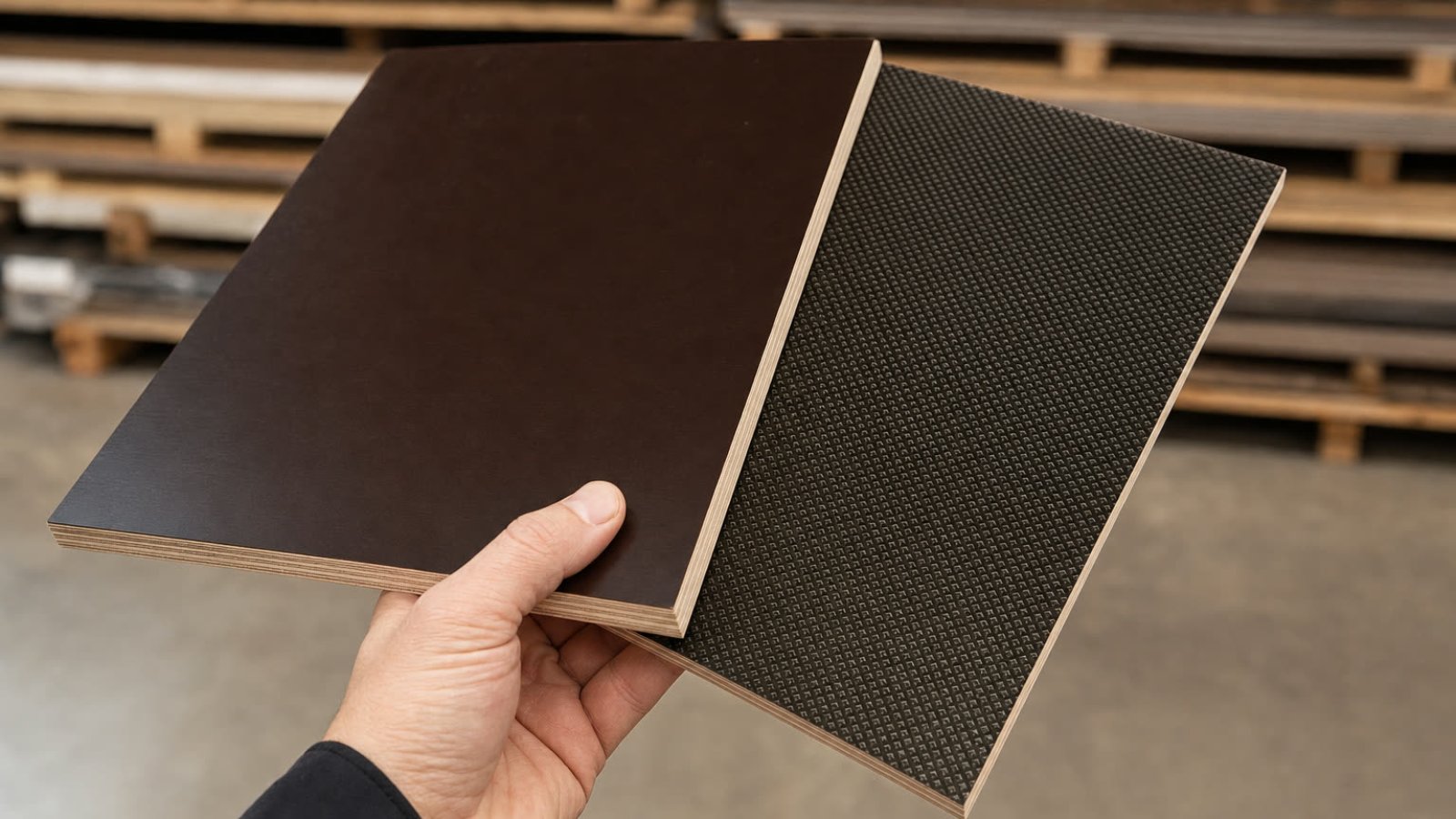
A technical guide to selecting birch plywood coating, thickness and format by application. It explains the differences between FF, FW, HEXA, melamine and raw panels, along with professional purchasing criteria.
Choosing the right board starts with translating the application into specific requirements. Do you need a smooth surface for formwork, an anti-slip face for a trailer, a white panel for furniture, or a raw base for machining? This birch plywood guide brings together the criteria worth reviewing before requesting a quotation: coating, thickness, format, bonding, emissions, face quality and conditions of use.
Birch plywood is used in projects where the panel must combine strength, stability and good cutting performance. In Spain, it is commonly found in construction, truck bodywork, flooring, industrial equipment and furniture. To understand how to choose birch plywood with confidence, avoid deciding solely on face appearance or price: two apparently similar boards can perform very differently when exposed to moisture, abrasion, loading and machining.
KEFI BOSQUE GROUP, S.L. holds more than 300 m³ of birch plywood in Mataró, Barcelona, and dispatches orders across Catalonia and the rest of Spain. The material comes from European and Central Asian sources and is available in thicknesses from 6.5 to 30 mm and in several formats. The following explains how to turn a construction or manufacturing requirement into a clear purchasing specification.
What is birch plywood?
Birch plywood is a board made from thin birch wood veneers arranged in crosswise layers and bonded with adhesive. Alternating the grain direction reduces its tendency to distort compared with a solid board of equivalent width. The result is a panel with a multi-layered edge, good strength for its weight and clean machining when suitable tools are used.
Exterior plywood should not be confused with just any board that withstands occasional contact with water. Suitability for humid or outdoor environments is linked to the bonding quality between veneers and to surface protection in actual use. An installation without drainage, with exposed edges or poorly sealed fixings can reduce service life even in a panel with suitable bonding.
Types of birch plywood by coating
The coating determines how the board interacts with its environment: cleaning, friction, surface resistance, appearance and ease of striking formwork. Before choosing, establish whether the face will remain visible, receive traffic, come into contact with concrete or be varnished afterwards. This comparison helps answer the common question about the difference between FF and FW plywood.
FF (Film Face): smooth phenolic
FF means Film Face. It is a birch board faced with smooth phenolic film, designed to provide a uniform face that is easy to clean. It is a common type of phenolic birch plywood for formwork, construction hoardings, truck bodywork components, industrial side panels and surfaces where a continuous finish is valued. The smooth face can make striking easier when the formwork system and release agents are selected correctly.
Choose smooth FF phenolic plywood when the priority is a regular, hard-wearing surface. Request information on edge treatment, film weight, format and the expected number of cycles; re-use depends on handling, cleaning, concrete, release agents and maintenance, not on a universal figure.
FW (Film Wire): anti-slip surface
FW, or Film Wire, generally combines one smooth face with another face embossed in a mesh pattern. The embossing increases grip and is therefore used for truck, van, trailer, container and platform floors. The surface should face the traffic side, while the smooth face may face the structure or the area that needs easier cleaning.
The difference between FF and FW plywood is primarily functional: FF meets a smooth-finish requirement, whereas FW meets a grip requirement. Do not replace an FW board with FF when reducing slips is the main requirement. Review the FW phenolic birch board and specify axle load, crossmember spacing and exposure to water before fixing it.
HEXA: hexagonal pattern
HEXA panels incorporate an anti-slip hexagonal pattern. They are chosen when grip performance is needed alongside a more pronounced appearance than conventional mesh. They are suitable for platforms, ramps, vehicle floors, stages and equipment projects. As with any flooring surface, the embossing must be considered together with thickness, the supporting structure and the fixing method.
HEXA phenolic plywood is the appropriate option when the pattern forms part of the specification. Before confirming it, check which face will receive the load and how perimeters, openings and drill holes will be finished to limit moisture ingress.
Melamine: FF, FW/HEXA and white
Melamine-faced boards are intended for applications where the visible finish, cleaning and production of repeatable components matter. This family may include smooth, embossed or white-faced configurations. Common uses include technical furniture, interior equipment, trolleys, linings and bespoke manufacture. Melamine should not be selected on colour alone: confirm the surface resistance and the panel’s functional face.
Raw plywood has neither film nor melamine and allows varnish, paint, decorative veneer or other finishing systems to be applied. It is suitable for furniture, prototypes, jigs, interiors, machined components and decorative work that uses the appearance of the birch edge. Compared with a finished board, it requires a decision on how faces and edges will be protected for the environment.
Select raw birch plywood if you require finishing freedom. Define the face grades, grain direction, need for varnishing and cutting tolerance in advance. For an outdoor flooring project, unprotected raw plywood is not equivalent to a coated formwork or transport board.
Type
Surface
Recommended use
Key question before buying
Phenolic FF
Smooth
Formwork, truck bodywork, industry
Do you need easy cleaning or striking?
Phenolic FW
Anti-slip mesh
Vehicle and platform floors
What loading and traffic will it receive?
Phenolic HEXA
Hexagonal embossing
Ramps, stages, technical floors
Do grip and visual pattern matter?
Melamine
Smooth, embossed or white
Furniture and lining
Which face will remain visible?
Raw
Birch veneer
Cutting, varnishing and decoration
What finish will be applied afterwards?
Available thicknesses and formats
Thickness is selected according to structural function and support geometry, not habit. KEFI Bosque offers 6.5, 9, 12, 15, 18, 21, 24, 27 and 30 mm. A thin thickness may work as a lining or lightweight furniture component; medium thicknesses are used in furniture, truck bodywork and technical applications; greater thicknesses are considered for floors, platforms, formwork and more demanding loads.
The available standard formats are 1220 × 2440, 1250 × 2500, 1500 × 3000 and 1525 × 3050 mm. Format affects cutting yield, finished-part stiffness, transport and handling. A larger sheet can reduce joints and waste but may require more operatives or equipment to move it. Prepare the cutting list before deciding: less waste and fewer joints may be more relevant than the cost per sheet.
Thickness
Typical use
Aspect to validate
6.5–9 mm
Lining, lightweight components, furniture
Support spacing and face finish
12–15 mm
Joinery, furniture, light truck bodywork
Required stiffness and joint type
18–21 mm
Floors, equipment, formwork
Load, support and coating
24–30 mm
Platforms and industrial use
Structural design and total weight
Standards and certifications: EN 314-2 class 3 and EN 13986 E1
Technical documentation is used to check that the board is suitable for its intended application. EN 314-2 covers plywood bonding quality requirements. Class 3 is associated with exterior conditions in terms of bonding quality. This is relevant to construction, transport and installations exposed to moisture, but does not remove the need to protect edges and correctly design joints.
EN 13986 brings together characteristics, conformity assessment and marking for wood-based panels used in construction. In the range described, the formaldehyde classification is E1, low emission. For construction work, tenders, furniture or customer specifications, request documentation applicable to the offered product and batch rather than assuming that every commercial designation covers the same requirements.
Applications by sector
Construction and formwork
In construction, a formwork panel must combine flatness, a face suitable for concrete and orderly maintenance. Smooth phenolic FF is often selected for this purpose. If you need a specific construction solution, also compare the yellow three-ply formwork board, understanding that it is a different product and that each system must be defined according to its process and number of re-uses.
Transport: trucks, trailers and containers
For transport, the requirement usually centres on a strong floor with grip. FW and HEXA may be suitable where an anti-slip surface is required; thickness is validated against loads, supports and fixings. Seal cuts, drill holes and edges before putting the vehicle into service. A well-chosen panel can fail prematurely if water enters through an unprotected perforation.
Furniture industry
In furniture, priorities vary between visible face, stability, finish, weight and machining. Raw plywood permits varnishes and lacquer finishes; melamine provides a finished face for repetitive production. Consider veneer visual direction, the exposed edge, fittings and face grade.
Marine applications
For marine uses, “marine plywood” should not be a generic label. The project may require specific species, glues, certifications, finish and procedures. A board with class 3 bonding may be suitable for certain exterior conditions, but a vessel or port installation requires analysis of immersion, salinity, ventilation, sealing and applicable standards. Consult before specifying a panel for this sector.
Floors and flooring
For vehicle floors, walkways or platforms, determine the surface pattern, thickness and supporting structure. FW and HEXA provide embossing; smooth FF may meet a different functional requirement. If the floor is outdoors and receives water, design slopes, drainage and periodic maintenance. For outdoor leisure areas, a non-equivalent but complementary alternative may be WPC composite decking.
How to check quality when buying
A structured check reduces supply errors. Start with the quotation and finish with a visual inspection of the material received. The aim is not to demand impossible perfection from wood, but to check that the specification matches the intended use.
Identify the product: species, coating, visible face and format.
Check the thickness: measure at several points with a suitable instrument and observe the stated tolerances.
Inspect faces and edges: look for transport damage, delamination, impacts, moisture or defects incompatible with your application.
Confirm documentation: request an EN 314-2 class 3 and EN 13986 E1 data sheet when it forms part of the specification.
Test in your process: make a trial cut and fixing before production, especially with new tools, varnishes or adhesives.
Storage and handling
Frequently asked questions
How do I choose birch plywood for a trailer floor?
Start with the load, spacing between supports, environment and fixing system. An FW or HEXA finish can provide grip; thickness must be validated by calculation or against the technical criteria of the vehicle manufacturer.
What is the difference between FF and FW?
FF has a smooth phenolic film; FW incorporates an anti-slip mesh face. Choose FF for a uniform surface and FW when floor grip is a primary requirement.
What does EN 314-2 class 3 mean?
It is a plywood bonding quality reference associated with exterior conditions. It should be complemented by an installation that protects edges, cuts and fixing points.
Does E1 mean the board contains no formaldehyde?
No. E1 is a low-emission classification according to the applicable documentation. Request technical information for the specific board if your project requires particular emissions requirements.
Can I use raw plywood outdoors?
Only if the project defines suitable protection for faces, edges and fixings, and if the board and bonding correspond to the conditions of use. For intensive exposure, consult the specification before installation.
Does KEFI Bosque deliver throughout Spain?
Yes. From Mataró, Barcelona, shipments are organised across Catalonia and the rest of Spain. To obtain a quotation, state the destination, number of sheets, format, unloading requirements and lead time.
Define the specification and request a quotation
The most effective way to use this birch plywood guide is to send a brief specification: application, coating, thickness, format, quantity, destination and required date. This makes it possible to confirm a birch plywood alternative that suits the project and a supply proposal for Spain.
Contact KEFI BOSQUE GROUP, S.L. at Avda. Jaume Recoder 88 P 8 PTA 4, 08301 Mataró (Barcelona): WhatsApp +34 690 288 718, telephone +34 654 073 786, sales@kefigroup.es or info@kefigroup.es. Request your quotation with stock availability and nationwide delivery.